Types of elections in India: Lok Sabha, Assembly, Rajya Sabha, President and more
India holds several kinds of election, and they work very differently. Some are decided by the public. Others are decided by MLAs, or by MPs. This is the map.
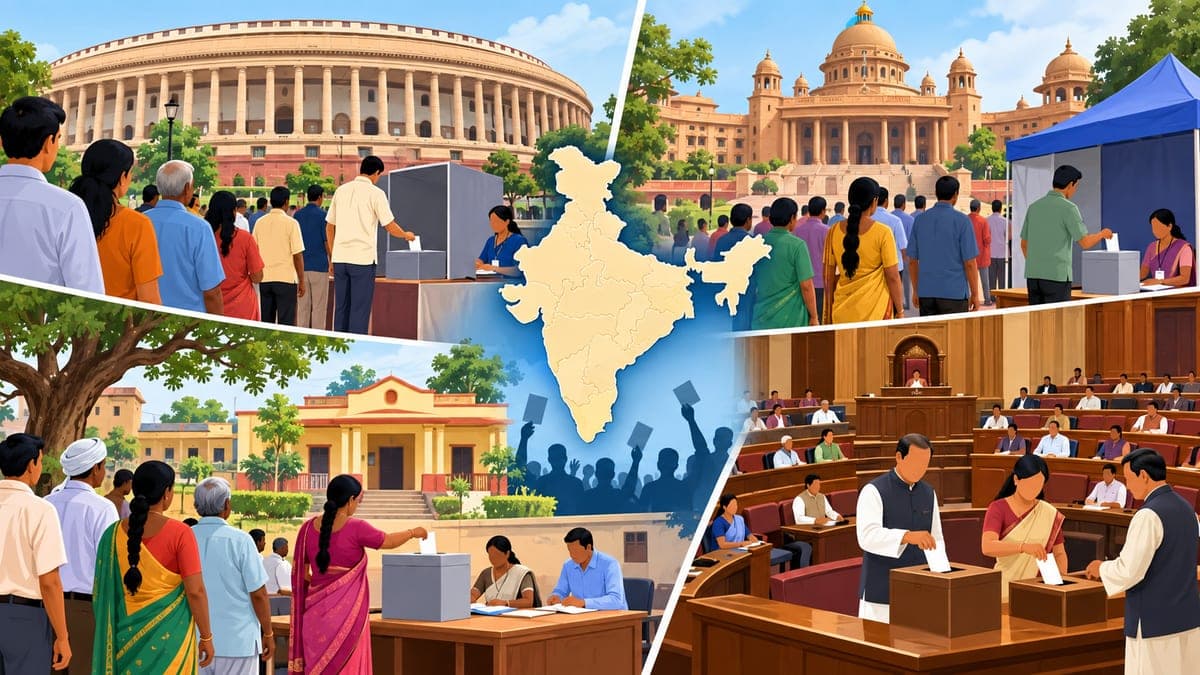
By the Janadesh Online editorial team. Facts last checked against the sources below on 25 September 2026.
All the elections at a glance
| Election | Who votes | How they are chosen | Run by |
|---|---|---|---|
| Lok Sabha | All registered voters | Direct election from territorial constituencies | Election Commission of India |
| State Legislative Assembly (Vidhan Sabha) | All registered voters | Direct election from territorial constituencies | Election Commission of India |
| Rajya Sabha | The elected MLAs of each state | Proportional representation by single transferable vote. 12 members are nominated by the President | Election Commission of India |
| Legislative Council (Vidhan Parishad) | Local bodies, graduates, teachers and MLAs | Different groups elect different shares. Single transferable vote for the elected members; the rest are nominated by the Governor | Election Commission of India |
| President | Elected members of both Houses of Parliament and of the state Assemblies | Single transferable vote, secret ballot, with weighted votes | Election Commission of India |
| Vice-President | Members of both Houses of Parliament | Single transferable vote, secret ballot | Election Commission of India |
| Panchayats and municipalities | Registered voters of the local area | Governed by Parts IX and IXA of the Constitution | State Election Commissions |
Direct elections: Lok Sabha and Assemblies
The Lok Sabha has members "chosen by direct election from territorial constituencies in the States" (Article 81(1)(a)). Its term is five years from its first sitting unless dissolved earlier, and during a national Emergency Parliament can extend it by law, one year at a time (Article 83(2)). State Assemblies are also directly elected. Who wins in each seat is decided by the plain plurality method explained in first past the post vs proportional representation. See how a Chief Minister is chosen and how a Prime Minister is chosen.
Indirect elections
- Rajya Sabha. Up to 238 representatives of the states and Union territories, plus 12 nominated by the President. It is never dissolved, and one-third of members retire every second year. See how Rajya Sabha elections work.
- Legislative Council. A Council has at most one-third of the Assembly's members and never fewer than 40. One-third are elected by local bodies, one-twelfth by graduates, one-twelfth by teachers, and one-third by MLAs; the rest are nominated by the Governor (Article 171).
- President. The electoral college is the elected members of both Houses of Parliament and the elected members of the state Legislative Assemblies. For this purpose Delhi and Puducherry count as states. Nominated MPs and members of Legislative Councils are not in the college. Voting is by single transferable vote and secret ballot (Article 55).
- Vice-President. Elected by the members of both Houses of Parliament by single transferable vote and secret ballot (Article 66). Article 66, unlike Article 54, does not say "elected", and All India Radio's report on the electoral roll for the Vice-President's election describes the college as including nominated Rajya Sabha members.
By-elections and local bodies
A by-election fills one seat that falls vacant between general elections, within six months in most cases. See what a bypoll is and the upcoming elections on this site.
Panchayat and municipal elections are conducted by State Election Commissions, headed by a State Election Commissioner appointed by the Governor, under Articles 243K and 243ZA. That is different from the Election Commission of India, which conducts the elections above.
Frequently asked questions
Which elections does the public vote in directly?
The Lok Sabha and state Legislative Assembly elections. The Rajya Sabha, Legislative Councils, President and Vice-President are elected indirectly, and local bodies have their own elections run by State Election Commissions.
Who elects the President of India?
The elected members of both Houses of Parliament and of the state Legislative Assemblies, with Delhi and Puducherry counted as states, by single transferable vote and secret ballot.
Who elects the Vice-President?
The members of both Houses of Parliament, by single transferable vote and secret ballot (Article 66).
Does the Election Commission of India run panchayat elections?
No. Panchayat and municipal elections are run by each state's State Election Commission.
Can the Lok Sabha be dissolved before five years?
Yes. Its term is five years from its first sitting unless it is dissolved sooner.
Sources
- Constitution of India, Article 81
- Constitution of India, Article 83
- Constitution of India, Article 80
- Constitution of India, Article 171
- Constitution of India, Article 54
- Constitution of India, Article 55
- Constitution of India, Article 66
- Constitution of India, Article 243K
- Constitution of India, Article 243ZA
- Constitution of India, Article 324
Janadesh Online is independent and not affiliated with the Election Commission of India. Rules and procedures can change between elections; the Commission’s own notices are the authority. Spotted an error? Tell us on the contact page.