
How a Chief Minister is chosen: what the Constitution says and what Governors do
Voters do not directly elect a Chief Minister. They elect MLAs, and the Constitution then works through the Governor and the Assembly. Here is the actual sequence, and where the rules end and convention begins.
By the Janadesh Online editorial team. Facts last checked against the sources below on 25 September 2026.
What the Constitution says
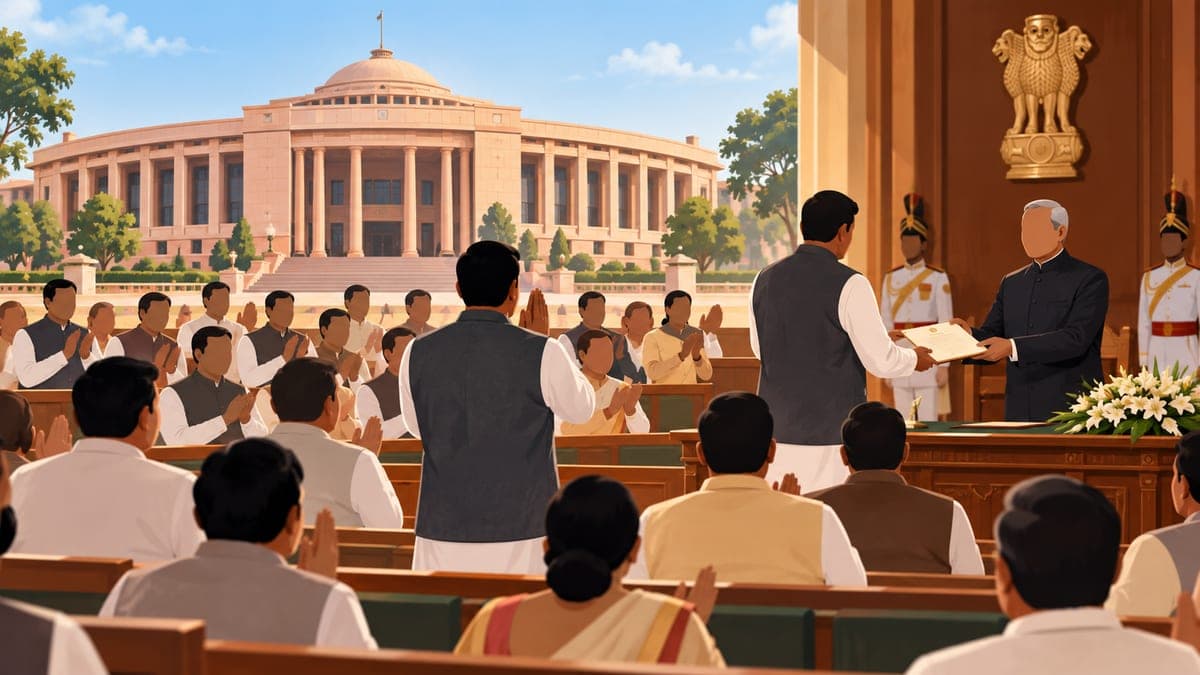
Article 164(1) is short: "The Chief Minister shall be appointed by the Governor". The other ministers are also appointed by the Governor, on the Chief Minister's advice, and all of them hold office during the Governor's pleasure.
The check on that power is in Article 164(2): the Council of Ministers is collectively responsible to the Legislative Assembly. A Chief Minister who loses the support of a majority of the House cannot govern. So although the appointment is the Governor's, in practice it has to go to someone who can carry the Assembly with them.
The Constitution does not use the phrases "single largest party" or "leader of the majority party" anywhere in these articles. Those are descriptions of what usually happens, not constitutional requirements.
From result to oath
- Results are declared
Voters have elected the members of the Vidhan Sabha.
- The Governor appoints a Chief Minister
Under Article 164(1). Normally this is the leader of the party or alliance that has the support of a majority of MLAs.
- Other ministers are appointed on the Chief Minister's advice
The Chief Minister forms the Council of Ministers that will aid and advise the Governor (Article 163).
- The Governor administers the oath
Ministers take the oath of office and of secrecy in the forms set out in the Third Schedule (Article 164(3)).
- The government must keep the House's confidence
The Council of Ministers is collectively responsible to the Assembly (Article 164(2)). The Governor summons the House under Article 174.
You can see the results of past state contests, including who became Chief Minister, on the Chief Ministers page and in each state's history under States.
When no party has a majority
This is where Governors' choices have been most argued over. The Sarkaria Commission, as recounted in the Punchhi Commission's report on Centre-State relations, recommended an order of preference for a Governor to follow when no party wins a clear majority.
- A group of parties that formed an alliance before the election
- The single largest party, staking a claim with the support of others, including independents
- A post-election coalition in which all the parties join the government
- A post-election alliance in which some parties join and the rest support from outside
The commission also suggested the Chief Minister prove a majority on the floor of the House within 30 days. The Punchhi Commission endorsed guidelines of this kind as constitutional conventions.
These are recommendations and conventions, not binding law. Legal commentary, such as a Bar & Bench column, says the Supreme Court has never definitively endorsed the order of preference and that the law on a Governor's choice after a hung verdict remains unsettled. In the Bommai case the Court expressly declined to decide who a Governor should invite after an election with no clear majority.
The floor test
Whether a government still has a majority is tested by a vote in the Assembly. In S.R. Bommai v. Union of India (1994), a nine-judge bench held that the proper course for testing the strength of a ministry is "holding the test on the floor of the House", and that this is not a matter of the private opinion of any individual, be they the Governor or the President.
In Subhash Desai v. Principal Secretary, Governor of Maharashtra (2023), a five-judge bench said a Governor's discretion to call a floor test is "not an unfettered discretion". It held that calling one needs objective material beyond a mere request, and that a floor test cannot be used to settle disputes inside a party. On the facts, the Court held the Governor was not justified in calling on Uddhav Thackeray to prove his majority, but that the Governor was justified in inviting Eknath Shinde to form the government, because Thackeray had already resigned.
Rules on size, and on who can be a minister
- 15%Maximum share of Assembly seats the Council of Ministers, including the CM, can occupy
- 12Minimum size of a state's Council of Ministers, including the CM
- 6 monthsHow long a non-member can remain a minister
- 2004Year the 15% cap took effect (91st Amendment)
- The 15% cap and the minimum of 12 came in with the 91st Amendment, in force from 1 January 2004.
- A member of either House of a state legislature who is disqualified under the Tenth Schedule is also barred from being appointed a minister for the period of disqualification (Article 164(1B)).
- A minister who is not a member of the state Legislature for six consecutive months ceases to be a minister at the end of that period (Article 164(4)). In S.R. Chaudhuri v. State of Punjab (2001) the Supreme Court held that repeatedly re-appointing a non-legislator as a minister every six months is "improper, undemocratic, invalid and unconstitutional", and that a non-member should get elected within the six months.
A pending change
The Constitution (130th Amendment) Bill, 2025 would provide for the removal of the Prime Minister, Chief Ministers and other ministers after 30 consecutive days in custody on serious charges. It was introduced on 20 August 2025 and referred to a Joint Parliamentary Committee. It is a bill, not law, and we have not been able to confirm its current stage.
Frequently asked questions
Who appoints the Chief Minister?
The Governor, under Article 164(1) of the Constitution. The other ministers are appointed by the Governor on the Chief Minister's advice.
Does the largest party always get to form the government?
No rule says so. The Constitution does not mention the "single largest party". After a hung verdict, the Sarkaria Commission recommended an order of preference that puts a pre-poll alliance first, but that is a recommendation, not law.
Can a person who is not an MLA become Chief Minister?
A minister who is not a member of the state Legislature for six consecutive months ceases to be a minister (Article 164(4)). So a non-member can be appointed but must get elected within six months. The Supreme Court has held that repeatedly re-appointing such a person is unconstitutional.
What is a floor test?
A vote in the Assembly to see whether the government has majority support. The Supreme Court held in the Bommai case that this is the proper way to test a ministry's strength, rather than the Governor's own assessment.
How many ministers can a state have?
Not more than 15% of the total members of the Legislative Assembly, and for a state not fewer than 12, including the Chief Minister.
Sources
- Constitution of India, Ministry of Law and Justice edition (as on 1 May 2024), PDF
- Supreme Court: S.R. Bommai v. Union of India, 11 March 1994
- Supreme Court: Subhash Desai v. Principal Secretary, Governor of Maharashtra, 11 May 2023
- Supreme Court: S.R. Chaudhuri v. State of Punjab, 17 August 2001
- Punchhi Commission on Centre-State Relations, Volume II (March 2010)
- PRS: The Constitution (130th Amendment) Bill, 2025
Janadesh Online is independent and not affiliated with the Election Commission of India. Rules and procedures can change between elections; the Commission’s own notices are the authority. Spotted an error? Tell us on the contact page.