
How Rajya Sabha elections work: MLAs vote, and the quota decides
You do not vote for the Rajya Sabha. State MLAs do, using a counting method built for several seats at once. Here is how it works and why some rules look unusual.
By the Janadesh Online editorial team. Facts last checked against the sources below on 25 September 2026.
Who votes, and for whom
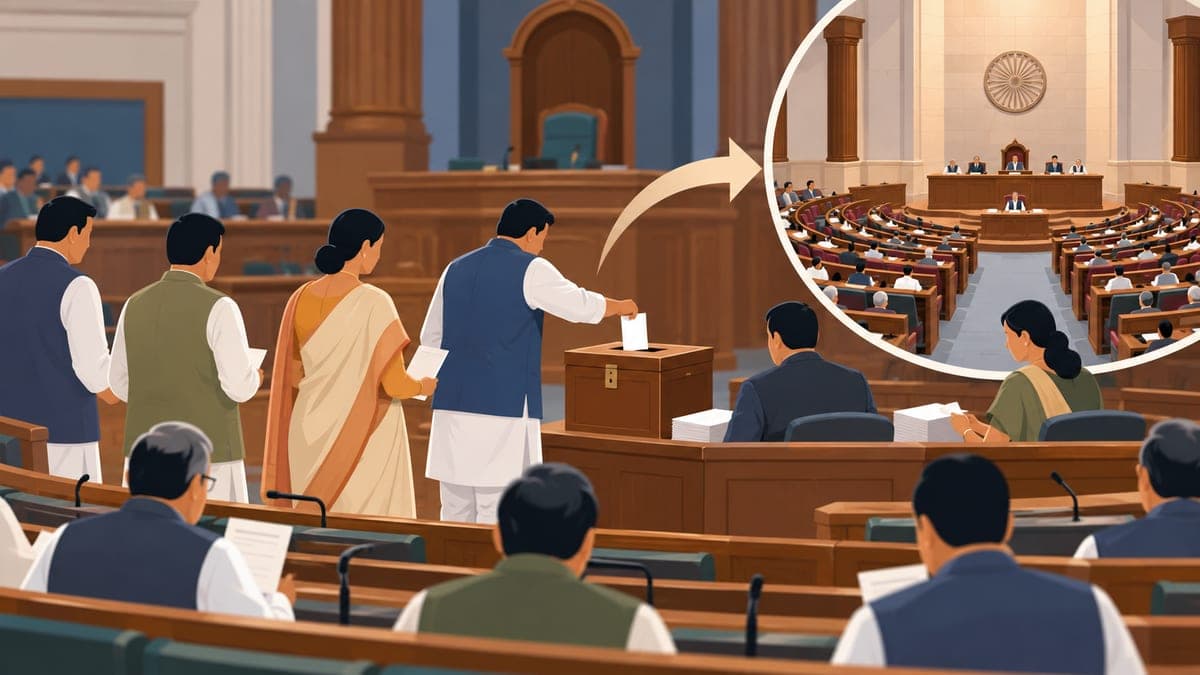
Article 80(4) says the representatives of each state in the Council of States "shall be elected by the elected members of the Legislative Assembly of the state in accordance with the system of proportional representation by means of the single transferable vote". So the voters are MLAs, not the public. Representatives of a Union territory are chosen as Parliament decides by law.
The House has up to 238 elected representatives of the states and Union territories, and 12 members nominated by the President for special knowledge or practical experience in literature, science, art and social service. The number of seats for each state is set out in the Fourth Schedule. For a side-by-side look at the Houses, see Lok Sabha, Rajya Sabha and Vidhan Sabha.
Terms and the election cycle
- The Rajya Sabha is not subject to dissolution. As nearly as possible one-third of its members retire every second year (Article 83(1)).
- A member's term is six years (section 154(1) of the Representation of the People Act, 1951).
- The election to fill retiring seats is notified on dates recommended by the Election Commission, and the notification cannot be issued more than three months before the retiring members' terms expire.
- A vacancy that arises mid-term is filled by a by-election, and the winner serves the rest of the predecessor's term. See what a bypoll is.
How the count works
When more than one seat is being filled, the Conduct of Elections Rules, 1961 give each valid ballot a value of 100, so that transfers of surplus votes can be worked out in whole numbers. The quota is then set by rule 76: divide the total value of valid ballots by one more than the number of seats, then add 1 and ignore any remainder.
- Set the quota
Total value of valid ballots divided by (number of seats + 1), then add 1, ignoring any fraction.
- Declare winners
A candidate whose value equals or exceeds the quota is declared elected (rule 78).
- Transfer surpluses
The value above the quota is passed on to the continuing candidates by next preference, dealing with the largest surplus first (rule 79).
- Exclude the lowest
If seats remain unfilled, the candidate lowest on the poll is excluded and their ballots are transferred by next preference (rule 80).
- Fill the last seats
When the number of continuing candidates equals the number of vacancies, they are elected (rule 81).
For a single seat, such as a by-election, each ballot has a value of 1 and the quota is half the total plus 1, ignoring any remainder (rule 75).
This is a summary of the rules, taken from a copy of the Conduct of Elections Rules that may be older than the current text. The Election Commission's returning officers apply the current rules.
Why the ballot is open
Since 28 August 2003, section 59 of the Representation of the People Act has provided that votes at every election to fill Council of States seats "shall be given by open ballot". The same 2003 Act removed the requirement that a candidate be an elector in the state they represent; a candidate now needs to be an elector for a parliamentary constituency anywhere in India.
In Kuldip Nayar v. Union of India (2006), a five-judge Constitution Bench upheld both changes. As summarised, it held that residence in the state is not a constitutional requirement under Article 80(4) and that secrecy of the ballot is not a fundamental right in this indirect election. The open ballot was introduced because party members were seen to be cross-voting under the cover of a secret ballot.
Why there is no NOTA
In Shailesh Manubhai Parmar v. Election Commission of India (21 August 2018), the Supreme Court held that NOTA cannot be used in Rajya Sabha elections and quashed the Commission's circulars that had introduced it. It reasoned that NOTA conflicts with the proportional representation system under Article 80(4), and that in an open-ballot indirect election it would indirectly encourage defection and corruption. For the option on Lok Sabha and Assembly ballots, see what NOTA is.
Frequently asked questions
Who elects Rajya Sabha members?
The elected members of each state's Legislative Assembly, using proportional representation by means of the single transferable vote (Article 80(4)). Union territory representatives are chosen as Parliament decides.
How long is a Rajya Sabha term?
Six years, with about one-third of the House retiring every second year. The House itself is never dissolved.
Do you have to live in the state you represent?
No. Since 2003 the law requires only that a candidate be an elector for a parliamentary constituency in India. The Supreme Court upheld this in Kuldip Nayar (2006).
Is the Rajya Sabha ballot secret?
No. Since 2003 votes in Rajya Sabha elections are given by open ballot, which the Supreme Court upheld in 2006.
Can voters choose NOTA in a Rajya Sabha election?
No. The Supreme Court held in 2018 that NOTA is inapplicable to Rajya Sabha elections.
Sources
- Constitution of India, Article 80
- Rajya Sabha at Work, chapter 2: Composition (PDF)
- Rajya Sabha: Frequently asked questions (PDF)
- The Representation of the People Act, 1951 (PDF, Delhi State Election Commission copy)
- Conduct of Elections Rules, 1961 (Part VII, counting for the Council of States)
- Supreme Court: Kuldip Nayar v. Union of India, 22 August 2006
- Supreme Court: Shailesh Manubhai Parmar v. Election Commission of India, 21 August 2018
Janadesh Online is independent and not affiliated with the Election Commission of India. Rules and procedures can change between elections; the Commission’s own notices are the authority. Spotted an error? Tell us on the contact page.