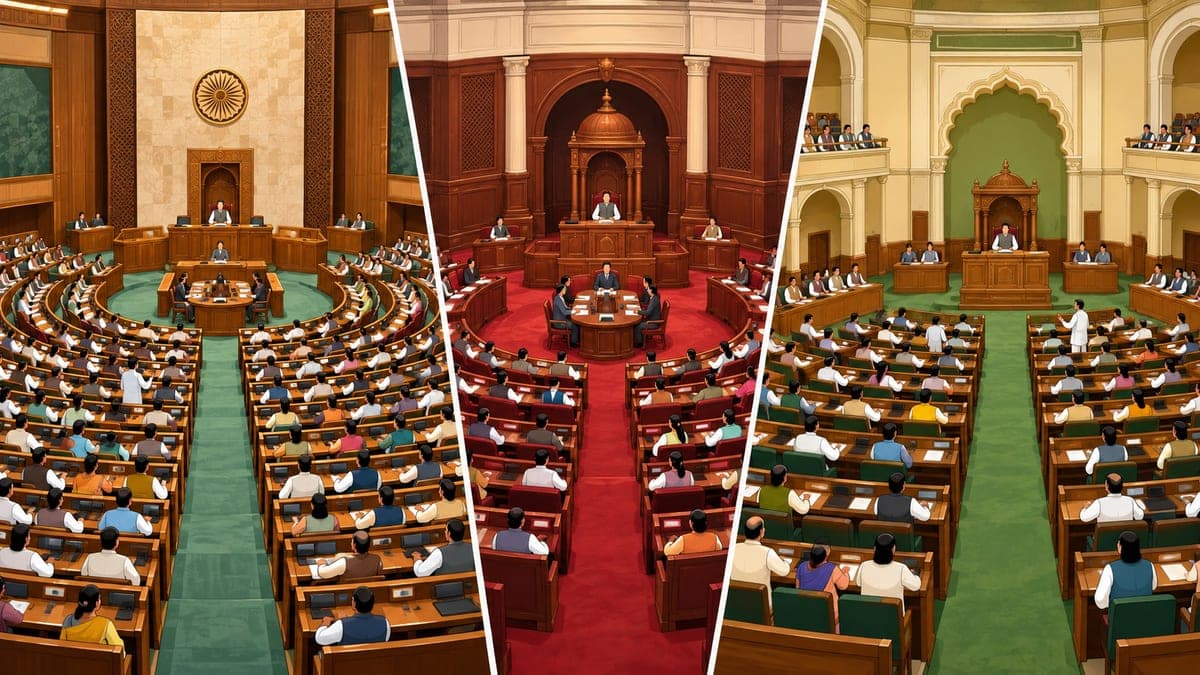
Lok Sabha vs Rajya Sabha vs Vidhan Sabha: how they differ
India has legislatures at two levels and, in Parliament, two Houses. They are chosen differently, last differently, and do different jobs. This guide puts them side by side.
By the Janadesh Online editorial team. Facts last checked against the sources below on 25 September 2026.
At a glance
| Lok Sabha | Rajya Sabha | Vidhan Sabha | |
|---|---|---|---|
| Full name | House of the People | Council of States | Legislative Assembly of a state |
| Size | Up to 550: not more than 530 from states and 20 from Union territories (Art. 81) | Up to 250: 238 from states and Union territories, 12 nominated. Present strength is 245 (Art. 80) | Between 60 and 500 per state; Goa, Sikkim, Mizoram and Arunachal Pradesh may have 30 or 40 (Art. 170) |
| How members are chosen | Direct election from territorial constituencies | State members elected by the elected MLAs, by proportional representation using the single transferable vote. 12 nominated by the President | Direct election from territorial constituencies |
| Term | Five years from its first meeting, unless dissolved sooner (Art. 83(2)) | Not subject to dissolution. As nearly as possible one-third of members retire every second year (Art. 83(1)) | Five years, unless dissolved sooner (Art. 172(1)) |
| Minimum age | 25 | 30 | 25 |
| Who can dissolve it | The President (Art. 85(2)(b)) | Cannot be dissolved | The Governor (Art. 174(2)(b)) |
| Money Bills | Introduced only here. Speaker's decision on what is a Money Bill is final (Art. 109, 110) | Cannot introduce them. Has 14 days to make recommendations; if not returned in that time, the Bill is deemed passed | Same 14-day period for the Legislative Council, where one exists (Art. 198) |
Lok Sabha
The Lok Sabha is the directly elected House of Parliament, and the one that decides whether a government stays in office, because the Council of Ministers is collectively responsible to it. The 530 ceiling for states came from the Goa, Daman and Diu Reorganisation Act of 1987, and the ceiling of 20 for Union territories from the 31st Amendment of 1973.
The actual strength of 543 is widely reported; the Constitution states only the maximum. The provision for nominating Anglo-Indian members ended with the 104th Amendment, in force from 25 January 2020, although the old wording still appears in Articles 81 and 331. Read more in how the Prime Minister is chosen, and see the Lok Sabha results on this site.
Rajya Sabha
The Rajya Sabha represents the states and some Union territories. Its own introduction page gives the present strength as 245: 233 elected representatives of the states and of the Union territories of Delhi, Puducherry and Jammu and Kashmir, and 12 nominated members. Nominated members are people with special knowledge or practical experience in literature, science, art and social service (Article 80(3)). The number of seats for each state is set out in the Fourth Schedule, on the basis of population.
Because it is never dissolved and only a third of it retires every second year, it is a continuing House. The step-by-step voting method is covered in how Rajya Sabha elections work.
Vidhan Sabha and Vidhan Parishad
Each state has a Legislative Assembly, the Vidhan Sabha, chosen by direct election. Article 170 fixes the range at not more than 500 and not less than 60 members, with exceptions in the Constitution for Sikkim, Goa and Arunachal Pradesh (not less than 30) and Mizoram (not less than 40). The First Schedule lists 28 states and 8 Union territories.
A few states also have a second House, the Legislative Council or Vidhan Parishad. Under Article 169, Parliament can create or abolish one if the state Assembly passes a resolution by a majority of its total membership and by two-thirds of members present and voting. A Council has at most one-third of the Assembly's strength and never fewer than 40 members. About one-third are elected by local bodies, one-twelfth by graduates, one-twelfth by teachers, and one-third by MLAs from among non-members; the rest are nominated by the Governor for work in literature, science, art, the co-operative movement and social service. Like the Rajya Sabha, a Council is not dissolved and one-third retire every second year (Article 172(2)).
Article 168 lists the states with two Houses. We have not verified an official current count of functioning Councils, so this page does not give one.
Who chooses whom
- VotersElect MLAs
In each Assembly constituency, in a state election.
- VotersElect MPs
In each Lok Sabha constituency, in a general election.
- MLAsElect Rajya Sabha members
The elected members of each state's Assembly vote by single transferable vote.
Frequently asked questions
Which House is more powerful?
Only the Lok Sabha can introduce a Money Bill and the Council of Ministers is collectively responsible to it, not to the Rajya Sabha. On a Money Bill the Rajya Sabha can only make recommendations within 14 days. The two Houses can also hold a joint sitting when they disagree on an ordinary Bill (Article 108).
How many members does the Rajya Sabha have?
The Constitution allows up to 250: 238 representing states and Union territories and 12 nominated by the President. The Rajya Sabha's own website gives the present strength as 245, of which 233 are elected and 12 nominated.
Can the Rajya Sabha be dissolved?
No. It is not subject to dissolution. As nearly as possible one-third of its members retire every second year.
What is the minimum age to be an MP or MLA?
25 for the Lok Sabha and the Vidhan Sabha, and 30 for the Rajya Sabha and the Legislative Council.
Does every state have a Legislative Council?
No. A Council exists only in some states. Parliament can create or abolish one if the state Assembly asks for it by a special majority.
Sources
- Constitution of India, Ministry of Law and Justice edition (as on 1 May 2024), PDF
- Rajya Sabha: Introduction
Janadesh Online is independent and not affiliated with the Election Commission of India. Rules and procedures can change between elections; the Commission’s own notices are the authority. Spotted an error? Tell us on the contact page.