
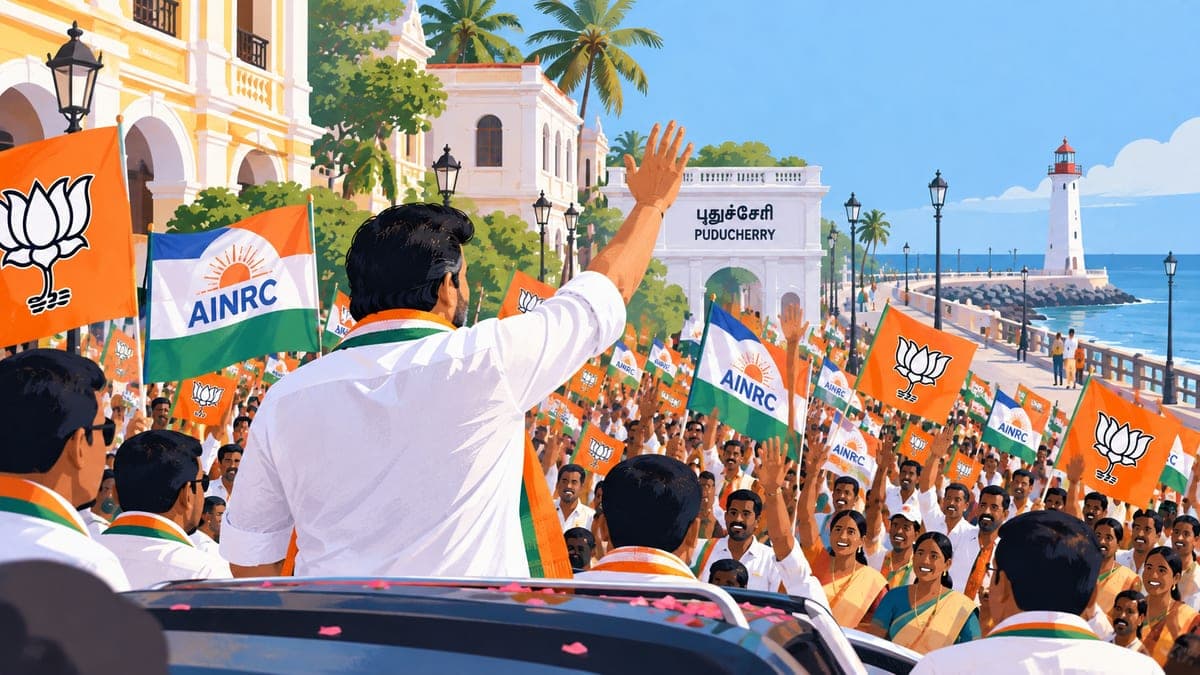
How the NDA won Puducherry in 2026: what the polls said and what happened
Puducherry is a small Assembly, but its 2026 result tells a clear story. Almost every exit poll expected the NDA led by N. Rangasamy’s AINRC to return, and it did, with 18 of 30 seats. Underneath that, 20 seats changed party, seven were decided by fewer than 1,000 votes, and a new party, TVK, took about one vote in six. This piece goes through what the polls said, what the Election Commission’s numbers show, and how little has been published about why.
By the Janadesh Online editorial team. Published 26 September 2026.
The short version
- 18seats won by the NDA parties, out of 30 (majority of the elected seats: 16)
- 10 → 12AINRC's seats, 2021 to 2026
- 16.7%TVK's vote share in its first Puducherry election; it won 2 seats
- about 90%turnout, the highest recorded for an Assembly election in the territory
The NDA in Puducherry is led by the AINRC and includes the BJP, the AIADMK and the LJK. Together they won 18 of the 30 elected seats: AINRC 12, BJP 4, AIADMK 1 and LJK 1. N. Rangasamy was sworn in as Chief Minister for the fifth time on 13 May 2026. Polling was on 9 April and counting on 4 May.
Three things stand out. First, the polls were broadly right about the winner, which sets Puducherry apart from its neighbour Tamil Nadu. Second, the NDA parties’ combined vote share fell from about 43.7% in 2021 to 38.7%, yet their seat count rose from 16 to 18; the opposition vote was split three ways this time. Third, the map was tight: 20 of the 30 seats went to a different party than in 2021, and 7 were won by fewer than 1,000 votes.
How the Assembly works, and where 2021 left things
Puducherry is a Union Territory with its own Legislative Assembly. Wikipedia’s description of the Assembly says it has 33 seats: 30 are elected and 3 are nominated. Counting only the 30 elected seats, the majority mark is 16. Wikipedia puts it at 17 for a house of 33. The NDA’s 18 elected seats clear both marks, so the nominated members do not change who has a majority. We have not found a reliable account of who was nominated after the 2026 election, so this piece counts elected seats only. (After the 2021 election, Wikipedia says the Lieutenant Governor appointed three BJP nominees.)
In 2021 the NDA of AINRC, BJP and AIADMK won 16 seats (AINRC 10, BJP 6), the Congress and DMK together won 8, and 6 independents won. Rangasamy was sworn in for a fourth term on 7 May 2021. Then in the 2024 Lok Sabha election the picture looked different: according to Wikipedia, the Congress candidate V. Vaithilingam won Puducherry’s single Lok Sabha seat with 52.7% of the vote to the BJP candidate’s 35.8%, a margin of 1,36,516 votes, and the Congress led in 28 of the 30 Assembly segments. Lok Sabha and Assembly elections are not directly comparable, and we did not find an analyst who explains the change between them.
What the polls said before voting
Very few pre-poll surveys of Puducherry were published. The one we could confirm in detail is a People’s Pulse pre-poll survey, which its own website says was carried out between 16 and 23 March 2026 with 2,000 respondents. It is an opinion poll taken weeks before voting. We found no other pre-poll with seat and vote-share figures, and we have not audited how People’s Pulse did this one.
| Survey forecast | Actual result | |
|---|---|---|
| NDA seats | 14 to 17 | 18 |
| Congress-DMK alliance seats | 9 to 11 | 6 |
| TVK seats | 2 to 4 | 2 (3 with its ally NMK) |
| Others | 1 to 2 | 3 independents |
| AINRC seats | 9 to 11 | 12 |
| BJP seats | 5 to 7 | 4 |
| NDA vote share | 34% to 36% | about 38.7% |
| Congress-DMK vote share | 30% to 32% | about 31.3% |
| TVK with its ally NMK, vote share | 16% to 18% | about 18.5% |
It is fair to say the survey got the direction right and TVK’s seat range and share about right. It under-called the NDA and AINRC, and it over-called the Congress-DMK alliance and the BJP. The same survey reported that 62% of respondents named Rangasamy as their preferred Chief Minister, and that 55% felt the NDA government deserved another chance. Those are the pollster’s findings, from its own website.
What the exit polls said
Exit polls ask people who have just voted. Several agencies published them on 29 April 2026. The table lists five agencies whose NDA and Congress-DMK ranges appear in at least two of the compilations we checked (The News Minute, Wikipedia and the aggregator pyinfo.in). We have not audited any agency’s method.
| Agency | NDA | Congress-DMK alliance |
|---|---|---|
| Axis My India | 16 to 20 | 6 to 8 |
| People's Pulse | 16 to 19 | 10 to 12 |
| Praja Poll | 19 to 25 | 6 to 10 |
| Kamakhya Analytics | 17 to 24 | 4 to 7 |
| JVC | 15 to 17 | 11 to 13 |
| Actual result | 18 | 6 |
Every agency in this table had the NDA ahead. The actual 18 sat inside the range of three of the five (Axis My India, People’s Pulse and Kamakhya Analytics). It was below Praja Poll’s range and above JVC’s. For the Congress-DMK alliance, the actual 6 fell inside three of the five ranges (Axis My India, Praja Poll, Kamakhya Analytics) and below the other two.
Axis My India also published vote shares, as reported by The News Minute: NDA 40%, Congress-DMK 30% and TVK with NMK 17%. The result, by our arithmetic, was about 38.7%, 31.3% and 18.5%.
TVK is where the sources disagree. The News Minute and pyinfo.in give People’s Pulse and Praja Poll 0 seats for TVK, but other compilations we saw gave People’s Pulse a different TVK range, so we have left TVK out of the table. Across the agencies on pyinfo.in the TVK-led alliance ranges from 0 to 7 seats, with one exception: that page lists Bench Mark with the TVK-led alliance at 12 to 14 seats and the NDA at 10 to 12. We could not confirm that from a second source, so it is not in the table. TVK won 2 seats, and 3 with its ally NMK.
What the results show
- AINRC12
- DMK5
- BJP4
- Independents3
- TVK2
- Congress1
- AIADMK1
- LJK1
- NMK (Neyam Makkal Kazhagam)1
Vote shares here are each party’s own votes divided by all votes counted, including NOTA. The LJK (1 seat, 2.3%) and the NMK (1 seat, 1.8%) are not in the table because they did not have a comparable 2021 entry in our data. The NMK is the ally of TVK, so TVK and NMK together won 3 seats and about 18.5%.
If you add up the parties in each camp, the 2026 line-up is this. The NDA parties (AINRC, BJP, AIADMK and LJK) got about 38.7% of the vote and 18 seats. Congress and the DMK together got about 31.3% and 6 seats. TVK and NMK got about 18.5% and 3 seats. Independents got about 8.7% and 3 seats. Which party sits in which camp follows the alliance line-ups reported by Wikipedia; our database does not yet hold alliance-level totals for 2026, so these sums are ours.
How the votes moved
Compare raw vote counts between 2021 and 2026 and the picture is mixed. About 8.66 lakh people voted in 2026 against 8.37 lakh in 2021, a rise of about 30,000 (3.5%). At the same time the electoral roll in our data shrank from about 10.24 lakh to about 9.51 lakh. Meanwhile, the votes for each party moved like this.
| Party or group | 2021 votes | 2026 votes | Change |
|---|---|---|---|
| AINRC | 2,16,249 | 2,00,292 | about 16,000 fewer |
| Congress | 1,31,393 | 1,51,934 | about 20,500 more |
| DMK | 1,54,858 | 1,19,036 | about 35,800 fewer |
| BJP | 1,14,298 | 1,05,583 | about 8,700 fewer |
| TVK | did not contest | 1,44,817 | new |
| Independents | 1,06,098 | 75,185 | about 30,900 fewer |
| NDA parties combined | 3,65,170 | 3,35,177 | about 30,000 fewer |
| Congress and DMK combined | 2,86,251 | 2,70,970 | about 15,300 fewer |
The NDA parties’ combined count includes the AIADMK, which contested 5 seats in 2021 and 2 in 2026, and the LJK in 2026. The AIADMK’s own votes dropped from about 34,600 to about 9,400 because it contested fewer seats. In 2021 the BJP, AINRC and AIADMK contested 9, 16 and 5 seats between them, and in 2026 the NDA parties contested 10, 16, 2 and 2, so their totals are not like for like across the two years.
This is arithmetic, not proof of who switched to whom. Turnout, first-time voters, new names on the roll and removed names all move these totals, and different seats were contested by different partners. Without a survey of individual voters, no one can say exactly where votes went.
Two smaller signs. The number of voters who pressed NOTA fell from 10,803 (about 1.3%) in 2021 to 6,633 (0.77%) in 2026. And the NTK, which contested 28 seats in both elections, fell from 3.4% to 1.4% and lost its deposit in all 28 seats in 2026. We do not know why either changed.
The seat map
Puducherry has 30 seats, and the same 30 seat names appear in our data for both 2021 and 2026, so we can compare each seat with its last result. In 20 of the 30, the winning party was different in 2026. In 10 it was the same.
| 2021 winner | 2026 winner | Seats |
|---|---|---|
| Congress or DMK | NDA parties | 5 |
| Independent | NDA parties | 4 |
| NDA parties | Congress or DMK | 4 |
| NDA parties | Independent, TVK or NMK | 3 |
| Independent | TVK or NMK | 2 |
| BJP | LJK (another NDA party) | 1 |
| Congress | Independent | 1 |
So the NDA parties gained 9 seats from others and lost 7, a net gain of 2. The seats they gained include Villianur, where the DMK’s R. Siva, the outgoing Leader of the Opposition according to Wikipedia, lost by 1,970 votes, and Lawspet, which the Congress had held. The four that moved from the NDA to the Congress or DMK were Kalapet, Nellithope, Raj Bhavan and Oussudu, the last being the Congress’s only seat.
A “flip” here only means the winning party’s label changed. Some winners appear to have changed seat or party themselves: the candidate names in our data suggest that A. Johnkumar, who won Kamaraj Nagar for the BJP in 2021, was the BJP winner in Mudaliarpet in 2026, and that Ak. Sai J. Saravanan Kumar, the BJP winner in Oussudu in 2021, won Thirubhuvanai for TVK in 2026. So these counts do not measure how many voters changed their minds.
By region, Wikipedia’s district table shows the NDA winning 14 of the 23 seats in the Puducherry region, 3 of 5 in Karaikal and the one seat in Yanam. In Puducherry region the Congress-DMK side won 5 and TVK with NMK won 3, with one independent. In Karaikal the DMK won 1 and an independent won 1. In Mahe, an independent, T. Ashok Kumar, won by 1,115 votes over the Congress, which had held the seat in 2021 by 300. In Yanam, AINRC’s Malladi Krishna Rao won by 4,568 and was sworn in as a minister. Our own data agrees with the district totals.
| Seat | Winner | Runner-up | Margin |
|---|---|---|---|
| Raj Bhavan | DMK | BJP | 287 |
| Kalapet | DMK | BJP | 447 |
| Indira Nagar | AINRC | TVK | 584 |
| Ariankuppam | AINRC | Congress | 603 |
| Thirubhuvanai | TVK | AINRC | 701 |
| Nellithope | DMK | an independent | 850 |
| Muthialpet | AINRC | Congress | 952 |
Seven seats went by fewer than 1,000 votes, 12 by fewer than 2,000, and 23 of the 30 by fewer than 5,000. The median margin was about 2,500. The largest were Kamaraj Nagar, where the LJK won by 10,205, and Thirunallar, where the BJP won by 9,526. Three of the DMK’s five wins were among the seven closest, and the Congress’s only win, in Oussudu, came by 4,018.
Rangasamy stood in two seats and won both: Mangalam by 7,050 votes over the DMK’s S.S. Rangan, and Thattanchavady by 4,441 over E. Vinayagam of the NMK. In Thattanchavady the Congress state president V. Vaithilingam, who won the Puducherry Lok Sabha seat in 2024, finished fourth with 2,990 votes and lost his deposit. Wikipedia says Rangasamy kept Mangalam, and lists a vacancy in Thattanchavady.
TVK in Puducherry
TVK contested Puducherry for the first time and fielded 28 candidates, according to our data and Wikipedia. It allied with the NMK, which was given 2 seats and won 1. TVK won Manavely and Thirubhuvanai, finished second in three seats (Indira Nagar, Oupalam and Ozhukarai), and third in most of the rest. Fifteen of its 28 candidates lost their deposits. Its 16.7% was the third-highest vote share of any party, behind AINRC and the Congress.
A party can poll well and win few seats when its votes are spread thin. Here that is what the numbers show: a share close to the DMK’s and BJP’s, but only two seats. We cannot tell you which other parties lost votes to TVK, and we do not claim what the seats would have looked like without it. For the party’s result in the neighbouring state, see our piece on how TVK won Tamil Nadu.
What analysts say happened
Here we have to be plain: we found very little published analysis of the Puducherry result itself. We did not find a post-poll survey with breakdowns by age, gender or community, and no signed analysis explaining the vote after the count. What we did find is below, with dates so you can tell what was written before the result.
- Rangasamy’s personal base. V. Shoba, writing in Open magazine on 20 March, before the vote, argued that Rangasamy’s authority has rested on presence, accessibility and welfare delivery rather than ideology or rhetoric. She also wrote that the NDA had internal tensions, and that a reduced mandate would leave him more dependent on the BJP while a decisive win would let him reassert himself on his own terms. She did not mention TVK. This is her view, from before the result.
- Voter mood, as measured by one pollster. People’s Pulse’s March survey found 62% naming Rangasamy as preferred Chief Minister and 55% saying the NDA government deserved another chance. It also reported that voters ranked the candidate first (40%), then the party (30%), and religion or caste and money at 10% each. That is a pre-poll survey by a private agency, and we have not checked its method.
- The Congress. Vaithilingam resigned as the state Congress president on 7 May, and ThePrint quoted his reason as taking moral responsibility for the defeat. That is his stated reason, not an analysis of what went wrong.
One thing the numbers let us say, as arithmetic and not as an analyst’s claim: AINRC, the AIADMK and the LJK together have 14 seats, two short of the 16 needed. The BJP’s 4 seats take the NDA to 18. That is arithmetic only, and we have not seen anyone analyse the balance inside the alliance after the result.
- 14 February 2026
The revised (SIR) voter list is published with 9,44,211 electors.
- 20 to 23 March 2026
Seat-sharing is settled: NDA on 20 March (AINRC 16, BJP 10, AIADMK 2, LJK 2), TVK with NMK on 22 March, Congress and DMK on 23 March.
- 9 April 2026
Polling day. Turnout is announced as 89.87%.
- 29 April 2026
Exit polls are published. All of those in our table give the NDA the most seats.
- 4 May 2026
Counting. The NDA wins 18 of 30.
- 7 May 2026
V. Vaithilingam resigns as Congress state president.
- 13 May 2026
Rangasamy is sworn in as Chief Minister.
The voter list and turnout
Puducherry went through the Election Commission’s Special Intensive Revision of the voter list before this election. According to a report by the news agency IANS on Prokerala, the final roll was published on 14 February 2026 with 9,44,211 electors. At the claims stage 41,492 names were added and 16,619 deleted. Wikipedia’s page on the exercise puts the roll before the revision at about 10.21 lakh, which would make the drop about 77,000 names (about 7.5%). Those two sources describe different stages, so we do not reconcile them. Our own database has about 9.51 lakh electors in 2026 against about 10.24 lakh in 2021.
On polling day, turnout was 89.87%, the highest recorded for an Assembly election in the territory since the first one in 1964, according to All India Radio. It said that with postal ballots and service votes the overall figure was expected to reach about 91.2%. Our database gives 91.1% for 2026, which matches that. For 2021 the sources differ: our database has about 81.7% and Wikipedia gives 83.42%. So the rise is somewhere between about 6 and 9 points depending on the basis used. In our data turnout ranged from 95.8% in Bahour to 78.7% in Mahe.
What we cannot tell you is whether the roll revision or the high turnout helped or hurt any party. We have not seen a seat-by-seat analysis for Puducherry linking either to the result.
After the result
Lieutenant Governor K. Kailashnathan administered the oath to Rangasamy on 13 May 2026, according to the Deccan Chronicle. Two ministers took the oath with him: Malladi Krishna Rao of the AINRC and A. Namassivayam of the BJP. Wikipedia’s page on the ministry says three more were sworn in on 17 June, for a six-member ministry of four from the AINRC and two from the BJP. For how a leader gets to be Chief Minister after an election, see our explainer.
Because Rangasamy won two seats and can hold only one, one of them has to fall vacant, and Wikipedia says it did: Thattanchavady. We could not confirm a date for a by-election. For how those work, see our explainer on bypolls.
What we do not know
- Why voters chose as they did. We found no post-poll survey and no signed analysis of the result, only the pre-poll survey and a pre-election magazine piece above.
- Which parties lost votes to TVK, or how the seats would have gone without it.
- Whether any nominated members were named after the 2026 election, and how the government counts them. Only the elected seats are used here.
- How TVK’s result compares with the exit polls: sources give different TVK ranges for the same agency.
- Whether the three independents support the government.
- Whether the voter-list revision affected the result.
How we did the numbers
Seats, votes, margins and seat changes are our own analysis of the results published by the Election Commission of India, from the same data that powers the Puducherry 2026 election page on this site. Vote shares are each party’s votes divided by all votes counted, including NOTA. Where we add parties into a camp, the groupings follow the alliance line-ups reported by Wikipedia and the sums are ours. Poll figures come from the outlets named, and views are credited to the person who wrote them. If you spot a number that does not match the Commission’s, tell us on the contact page.
Frequently asked questions
How many seats did the NDA win in the 2026 Puducherry election?
The NDA won 18 of the 30 elected seats: AINRC 12, BJP 4, AIADMK 1 and LJK 1. The majority mark is 16 of the elected seats. N. Rangasamy was sworn in as Chief Minister for the fifth time on 13 May 2026.
Did the exit polls get Puducherry right?
On the winner, yes. Every exit poll in our table gave the NDA the most seats, and the actual 18 fell inside three of the five ranges. TVK’s numbers were less consistent, because sources give different ranges for it.
How did TVK do in Puducherry?
TVK contested 28 seats, won 2 and got about 16.7% of the vote, the third-highest share of any party. Its ally NMK won 1 seat. Fifteen of its 28 candidates lost their deposits.
How did the Congress and the DMK do?
Together they won 6 seats, down from 8 in 2021: the DMK 5 and the Congress 1. The DMK’s vote share fell from about 18.5% to 13.7% while the Congress’s rose from 15.7% to 17.5%, but in our data the Congress contested 22 seats this time against 14 in 2021. (Sources differ on how many seats it contested in 2026.)
Was the turnout a record?
Yes. Polling-day turnout was 89.87%, the highest recorded for an Assembly election in the territory, according to All India Radio. With postal ballots the overall figure was expected to be about 91.2%.
Explore the data
Every number in this piece can be checked seat by seat on Janadesh Online.
- Puducherry 2026 resultsEvery seat, party and margin
- Puducherry election historyAssembly and Lok Sabha, all years
- AINRCSeats and vote share
- BJPSeats and vote share over the years
- CongressSeats and vote share over the years
- DMKSeats and vote share over the years
- TVKSeats and vote share
- Chief Ministers of PuducherryWho has held the office
Sources
- Wikipedia: 2026 Puducherry Legislative Assembly election
- The News Minute: exit polls for Puducherry (29 April 2026)
- People’s Pulse: Puducherry pre-poll survey, March 2026
- pyinfo.in: Puducherry exit polls 2026
- All India Radio: Puducherry records highest-ever turnout of 89.87 per cent
- Deccan Chronicle: Rangasamy sworn in as Puducherry Chief Minister for the fifth time
- Wikipedia: Fifth Rangaswamy ministry
- Wikipedia: 16th Puducherry Assembly
- Wikipedia: Puducherry Legislative Assembly
- Wikipedia: 2021 Puducherry Legislative Assembly election
- Wikipedia: 2024 Indian general election in Puducherry
- ThePrint: Vaithilingam quits as PCC president
- Open magazine: V. Shoba on Puducherry 2026 (20 March 2026)
- DT Next: TVK wins two seats in Puducherry Assembly polls
- Prokerala (IANS): final electoral roll published in Puducherry after SIR
- Wikipedia: Special Intensive Revision
Janadesh Online is independent. Results are from the Election Commission of India; opinions and explanations are credited to the people and organisations who gave them. Spotted an error? Tell us on the contact page.