
How the Vice-President of India is elected, and what the office does
The Vice-President is chosen by MPs alone, with every vote worth one. The office also makes its holder Chairman of the Rajya Sabha. Here is the process, using the 2025 election as an example.
By the Janadesh Online editorial team.
Who votes
Article 66(1) says the Vice-President is elected by an electoral college of the members of both Houses of Parliament. Unlike the presidential election, the word "elected" does not appear, so the 12 members nominated to the Rajya Sabha vote as well, and State Assemblies play no part. The vote is by proportional representation with the single transferable vote, and by secret ballot. Each member's vote has a value of 1, as the Election Commission states.
- 788Full strength: 233 elected and 12 nominated in the Rajya Sabha, 543 in the Lok Sabha
- 782Members in the college when the schedule was announced, the rest being vacancies
- 781Electors eligible to vote on polling day
- 767Electors who voted, of whom 15 ballots were invalid
The two elections compared
- Elected MPs and elected MLAs (including Delhi and Puducherry)
- Nominated members do not vote
- Votes carry different values
- 50 proposers and 50 seconders
- A petition needs 20 electors if no candidate files it
- Vacancy must be filled within six months
- All MPs of both Houses
- Nominated Rajya Sabha members vote
- Every vote is worth one
- 20 proposers and 20 seconders
- A petition needs 10 electors if no candidate files it
- Vacancy filled "as soon as possible", with no stated outer limit
Who can stand, and the nomination
Article 66(3) requires a candidate to be a citizen of India, to have completed 35 years, and to be qualified for election as a member of the Council of States (the Rajya Sabha). A holder of an office of profit under the Union or a State cannot stand, except that the President, Vice-President, a Governor or a Union or State minister is not counted as holding one. The Vice-President cannot be a member of either House of Parliament or of a State legislature, and a member elected to the office is deemed to have vacated the seat on taking office (Article 66(2)).
- 7 Aug 2025
Notification calling the election.
- 21 Aug
Last date for nominations, between 11 am and 3 pm to the Returning Officer.
- 22 Aug and 25 Aug
Scrutiny of nominations, then the last date to withdraw.
- 9 Sep
Poll from 10 am to 5 pm in Parliament House, with counting the same day.
A nomination paper needs at least 20 electors as proposers and 20 as seconders, a certified copy of the candidate's entry in the parliamentary electoral roll, and a deposit of Rs 15,000. A candidate may file up to four papers, and an elector can back only one candidate. As in the presidential election, the deposit is forfeited if the candidate gets no more than one-sixth of the votes needed to win. The Returning Officer is the Secretary General of the Lok Sabha or Rajya Sabha by rotation; in 2025 it was the Rajya Sabha's.
Voting and counting
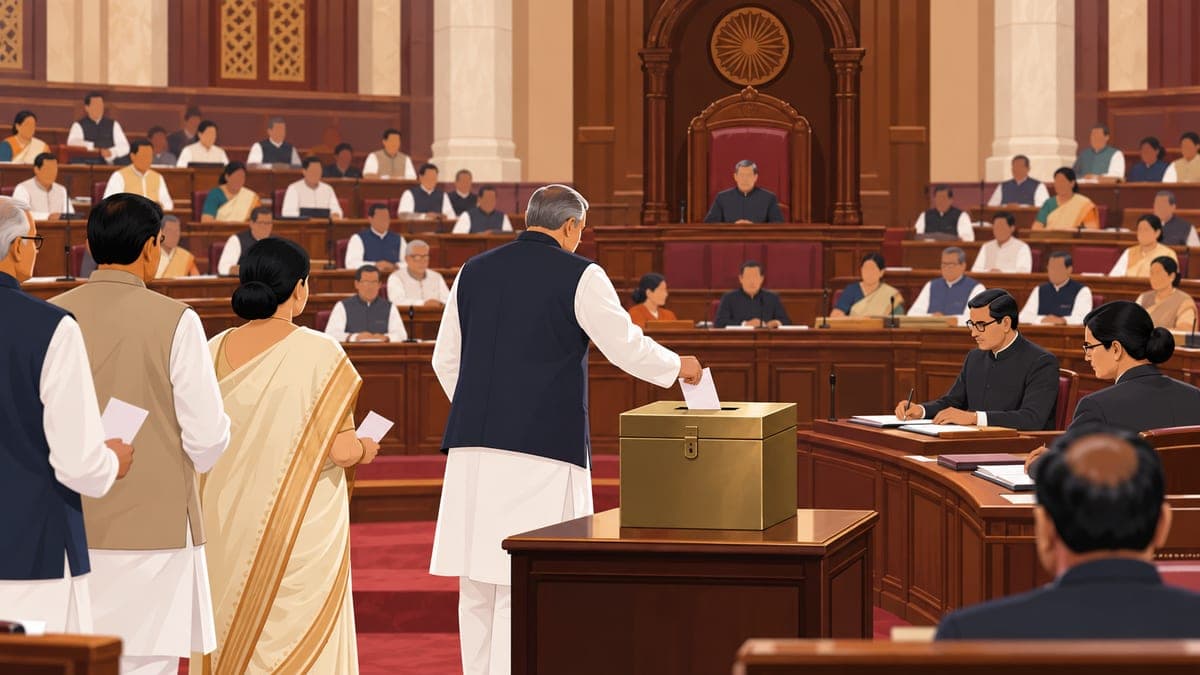
The mechanics match the presidential poll, except that each ballot counts as one vote. Electors mark preferences in figures with the pen the Commission supplies; only the first preference is compulsory. The Commission says the ballot is secret, with no open voting, and parties cannot issue a whip to MPs for this election.
- Count first preferences
Valid ballots are sorted by first preference, one vote each.
- Find the quota
Total valid votes divided by two, plus one, ignoring any remainder.
- Exclude and transfer
If nobody reaches the quota, the lowest candidate is excluded and those ballots pass to the next available preference.
- Declare
The Returning Officer declares the winner once a candidate reaches the quota, or when only one continuing candidate remains.
On the 2025 figures (767 voted, 15 invalid), there were 752 valid ballots, which gives a quota of 377 under that rule. That arithmetic is ours, not an official figure. The Election Commission's release on 10 September 2025 records C.P. Radhakrishnan as declared elected on 9 September 2025, as the fifteenth Vice-President. We give no vote tally because we did not fetch one from an official source.
The office: Rajya Sabha Chairman, term and vacancy
The Vice-President is ex officio Chairman of the Rajya Sabha (Articles 64 and 89) and cannot hold any other office of profit. The Chairman does not vote in the first instance but has a casting vote if the votes are equal (Article 100(1)). When the Chairman's office is vacant, or the Vice-President is acting as President, the Deputy Chairman performs the duties (Article 91). If the President's office falls vacant, the Vice-President acts as President until a new President takes office (Article 65).
The term is five years, and the Vice-President continues until a successor enters office. The Vice-President may resign by writing to the President, and can be removed by a resolution of the Rajya Sabha passed by a majority of all its then members and agreed to by the Lok Sabha, after at least 14 days' notice (Article 67). The Vice-President takes an oath before the President (Article 69).
When the office falls vacant by death, resignation, removal or otherwise, Article 68(2) says the election is held "as soon as possible" after the vacancy, and the winner gets a full five-year term. Unlike Article 62(2) for the President, it names no six-month limit. In 2025 the Commission recorded that the office had fallen vacant by a Ministry of Home Affairs notification dated 22 July 2025; it announced the schedule on 1 August and the poll was held on 9 September. Disputes go to the Supreme Court under Article 71, on a petition within 30 days by a candidate or by 10 or more electors.
Frequently asked questions
Who elects the Vice-President?
The members of both Houses of Parliament, including the 12 nominated Rajya Sabha members, by secret ballot using the single transferable vote.
Do State legislators take part?
No. Unlike the presidential election, the Vice-Presidential electoral college has only MPs.
How many electors must support a candidate?
At least 20 as proposers and 20 as seconders, with a security deposit of Rs 15,000.
Is there a deadline to fill a vacancy?
Article 68(2) says as soon as possible after the vacancy. It does not set the six-month limit that Article 62(2) sets for the President.
Does someone who fills a vacancy serve only the remainder of the term?
No. Under Article 68(2) the person elected serves a full five-year term from entering office, subject to Article 67.
When was the most recent Vice-Presidential election?
The poll was held on 9 September 2025, the 17th Vice-Presidential Election. As of 25 September 2026 we found no announced schedule for another.
Explore the data
Want to see this in real numbers? These pages on Janadesh Online show it for every election we cover.
Sources
- Constitution of India, Article 64
- Constitution of India, Article 65
- Constitution of India, Article 66
- Constitution of India, Article 67
- Constitution of India, Article 68
- Constitution of India, Article 69
- Constitution of India, Article 71
- Constitution of India, Article 89
- Constitution of India, Article 91
- Constitution of India, Article 100
- The Presidential and Vice-Presidential Elections Act, 1952 (PDF)
- The Presidential and Vice-Presidential Elections Rules, 1974 (PDF, Puducherry CEO copy)
- PIB: Election to the Office of the Vice-President of India, 2025 (ECI press note, 1 August 2025)
- PIB: Election Commission notifies schedule for Vice-Presidential Election 2025 (7 August 2025)
- PIB: Vice-Presidential Election 2025 (ECI, 10 September 2025)
Janadesh Online is independent and not affiliated with the Election Commission of India. Rules and procedures can change between elections; the Commission’s own notices are the authority. Spotted an error? Tell us on the contact page.