
How the President of India is elected: the electoral college and the value of a vote
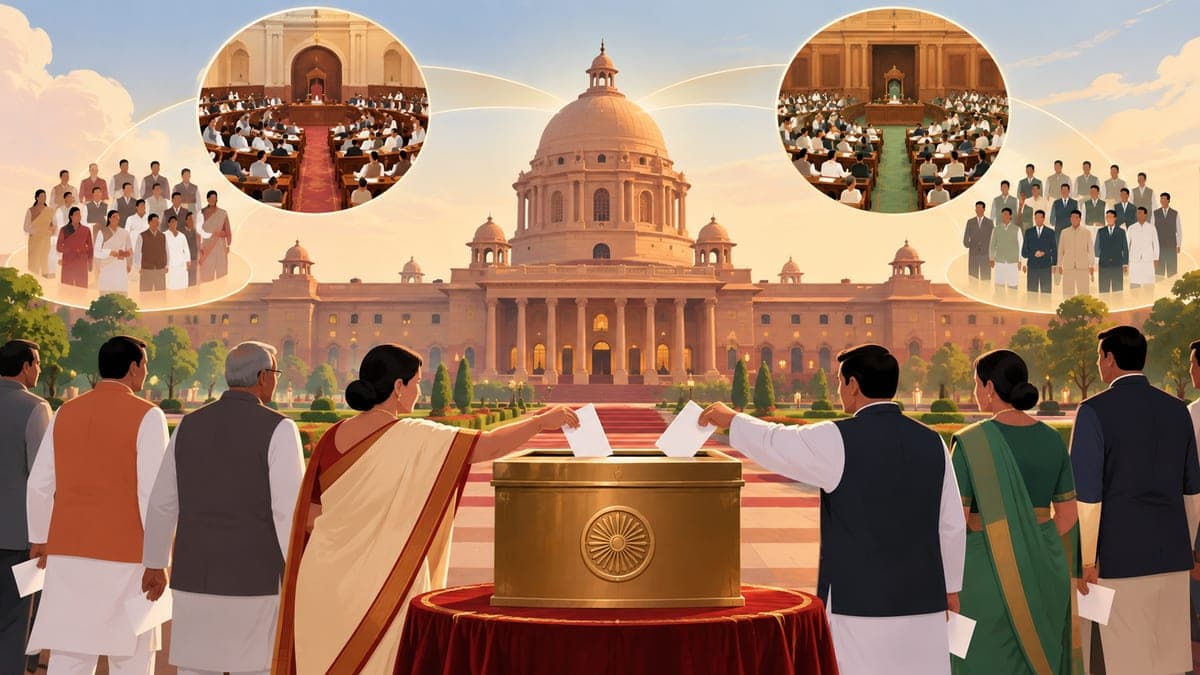
Citizens do not vote for the President. An electoral college of elected MPs and MLAs does, and their votes carry different weights. Here is how the college is made up, how the weights work and how the count is done.
By the Janadesh Online editorial team.
Who votes: the electoral college
Article 54 says the President is elected by an electoral college of the elected members of both Houses of Parliament and the elected members of the Legislative Assemblies of the States. The Constitution says that for this purpose "State" includes the National Capital Territory of Delhi and the Union Territory of Puducherry, so their MLAs vote too.
- Nominated members of the Lok Sabha, Rajya Sabha and State Assemblies are not in the college.
- Members of State Legislative Councils are not electors either.
- Parties cannot issue a whip to their members for this vote, according to the Election Commission.
- 10,86,431Total value of all votes in the college
- 5,43,231Combined value of the MLAs' votes
- 5,43,200Combined value of the MPs' votes
- 700Value of each MP's vote (as reported by PRS India)
Why votes have different values
Article 55 aims at uniformity in the scale of representation of the different States, and parity between the States as a whole and the Union. So each elector's vote is given a value, and a ballot counts as that many votes. The value for an MLA depends on the State's population and the size of its Assembly. The value for an MP is then set so that MPs as a group carry the same total weight as all the MLAs.
- Value of an MLA's vote
Divide the State's population by the number of elected MLAs, then divide by 1,000.
- Round
Take the whole number. If the remainder is 500 or more, add one.
- Total for the State
Multiply the MLA's vote value by the number of elected seats in that Assembly.
- Value of an MP's vote
Add up the totals of all the States and divide by the number of elected MPs. A fraction over one-half counts as one.
The population used is not the latest census. The Constitution (Eighty-fourth) Amendment Act, 2001 provides that until figures for the first census taken after 2026 are published, the 1971 census is used. The values are recalculated for each election because the number of elected members changes. The MP value was 708 in 2017 and 700 in 2022 (as reported by PRS India); Jammu and Kashmir had no Assembly in 2022 and so had no MLA votes in the college.
| State | 1971 population | Elected MLAs | Value of each MLA's vote |
|---|---|---|---|
| Andhra Pradesh | 2,78,00,586 | 175 | 159 |
| Sikkim | 2,09,843 | 32 | 7 |
Who can stand, and how to be nominated
Under Article 58 a candidate must be a citizen of India, have completed 35 years of age, and be qualified for election as a member of the Lok Sabha. A person holding an office of profit under the Union, a State or a government-controlled local authority is not eligible, except that the President, Vice-President, a Governor or a Union or State minister is not treated as holding one. A sitting President can stand again (Article 57). A member of Parliament or of a State legislature who is elected President is deemed to have vacated the seat on taking office (Article 59).
| Requirement | Rule |
|---|---|
| Proposers and seconders | At least 50 electors as proposers and 50 as seconders |
| One paper per elector | An elector may subscribe only one nomination paper |
| Security deposit | Rs 15,000, in cash or by receipt from the Reserve Bank or a Government Treasury |
| Nomination papers | Up to four per candidate, delivered between 11 am and 3 pm to the Returning Officer, not on a public holiday |
| Electoral roll | A certified copy of the candidate's entry in the parliamentary electoral roll |
The deposit is forfeited if the candidate loses and gets no more than one-sixth of the votes needed to win. The Returning Officer is the Secretary General of the Lok Sabha or Rajya Sabha by rotation; in 2022 it was the Rajya Sabha's.
Voting and counting
- Notification
Issued on or after the sixtieth day before the term ends. In 2022: 15 June.
- Last date for nominations
The 14th day after the notification. In 2022: 29 June.
- Scrutiny
The next day. In 2022: 30 June. Withdrawals close two days later (2 July).
- Poll
Not earlier than 15 days after withdrawals close. In 2022: 18 July, with counting on 21 July.
The ballot is secret and carries no symbols. The elector writes 1 against a first choice and may mark further preferences in figures, not words. Only the first preference is compulsory, and a ballot without a 1 is invalid. The Commission supplies a special pen, and using another pen invalidates the vote. MPs vote in Parliament House and MLAs in their own Assembly buildings.
- Credit first preferences
Each ballot counts at the value of the elector who cast it.
- Set the quota
Total value of valid votes, divided by two, plus one, ignoring any remainder.
- Declare or exclude
Anyone at or above the quota is elected. If none, the lowest candidate is excluded.
- Transfer
The excluded candidate's ballots pass to the next available preference at the same value. Repeat until one candidate reaches the quota.
If all 10,86,431 votes in 2022 had been valid, the quota would have been 5,43,216 (PRS India). The actual quota depends on the valid votes polled. If only one candidate is validly nominated after withdrawals, the Returning Officer declares that person elected without a poll (section 8).
Term, vacancy and disputes
The President serves five years from entering office (Article 56) and stays on until a successor takes charge. An election for an ending term must be completed before it expires (Article 62(1)). If the office falls vacant by death, resignation, removal or otherwise, an election must be held as soon as possible and no later than six months after the vacancy (Article 62(2)). Meanwhile the Vice-President acts as President (Article 65). If both offices are vacant, the Chief Justice of India, or the senior-most available Supreme Court judge, discharges the functions under the President (Discharge of Functions) Act, 1969.
Under Article 71, all doubts and disputes about the election are decided by the Supreme Court, and its decision is final. An election petition must be presented within 30 days of the declaration, by a candidate or by 20 or more electors together. The election cannot be challenged merely because a seat in the electoral college is vacant. If the Court declares an election void, acts done by the person before the decision remain valid. By our own calculation (not an official announcement), the term that began after the July 2022 election runs to about July 2027, so the next ordinary election must be completed before then under Article 62(1); we have not seen an announced date.
Frequently asked questions
Do ordinary voters take part in electing the President?
No. The electors are the elected members of both Houses of Parliament and of State and Delhi and Puducherry Legislative Assemblies.
Do nominated MPs or MLAs vote?
No. Nominated members of Parliament and of the Assemblies are not in the electoral college, and neither are members of Legislative Councils.
Why does an MLA's vote differ from state to state?
The value depends on the State's 1971 population and the number of elected MLAs. PRS India states 208 for Uttar Pradesh and 7 for Sikkim; the ECI 2017 booklet works through Andhra Pradesh (159).
Why is the 1971 census still used?
The 84th Amendment (2001) freezes the population base at the 1971 census until figures for the first census after 2026 are published.
How many people must back a candidate?
At least 50 electors as proposers and 50 as seconders, plus a deposit of Rs 15,000.
Who settles a dispute over the result?
The Supreme Court alone, on a petition filed within 30 days of the declaration (Article 71 and section 14 of the 1952 Act).
Explore the data
Want to see this in real numbers? These pages on Janadesh Online show it for every election we cover.
Sources
- Constitution of India, Article 54
- Constitution of India, Article 55
- Constitution of India, Article 56
- Constitution of India, Article 57
- Constitution of India, Article 58
- Constitution of India, Article 59
- Constitution of India, Article 62
- Constitution of India, Article 71
- The Presidential and Vice-Presidential Elections Act, 1952 (PDF)
- The Presidential and Vice-Presidential Elections Rules, 1974 (PDF, Puducherry CEO copy)
- ECI press note on the 2022 presidential election, 9 June 2022 (PDF, Meghalaya CEO copy)
- ECI: Election to the Office of President of India, 2017 (booklet, Kerala CEO copy)
- PRS: How India will elect its next President
- The President (Discharge of Functions) Act, 1969, section 3
Janadesh Online is independent and not affiliated with the Election Commission of India. Rules and procedures can change between elections; the Commission’s own notices are the authority. Spotted an error? Tell us on the contact page.