
What is delimitation? How constituencies are drawn, and why the freeze matters
Delimitation decides how many seats each state gets and where the lines of each constituency run. It has been frozen for decades, and 2026 has brought it back into the news.
By the Janadesh Online editorial team. Facts last checked against the sources below on 25 September 2026.
What delimitation is
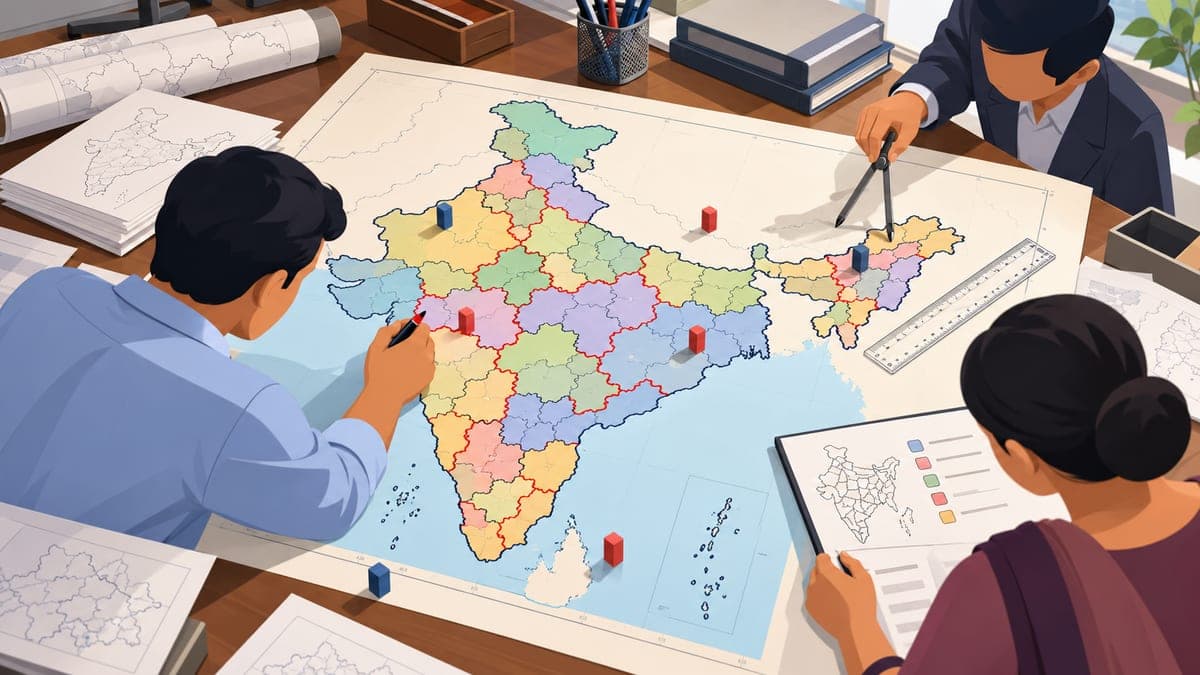
Delimitation is the redrawing of constituency boundaries, and the setting of how many seats each state has, so that constituencies stay roughly equal in population. The Constitution asks for this after every census. Article 82 says that upon completion of each census, the allocation of seats and the division of each state into constituencies shall be readjusted "by such authority and in such manner as Parliament may by law determine".
The aim written into Article 81(2) is that the ratio between a state's seats and its population is, so far as practicable, the same for all states, and that each constituency in a state has, so far as practicable, the same population. The same rule for state Assemblies is in Article 170(2). See Lok Sabha, Rajya Sabha and Vidhan Sabha compared for how the Houses differ.
Why it has been frozen
- 1971Census used to fix each state's share of Lok Sabha seats
- 2001Census used to divide each state into constituencies
- 2026Year after which the first census lifts the freeze
- 2002Year of the Delimitation Act now in force
A proviso to Articles 81, 82 and 170 says no readjustment is needed of the allocation of seats to states as readjusted on the 1971 census, or of the division into constituencies as readjusted on the 2001 census, until the figures of "the first census taken after the year 2026" are published. The 1971 freeze on the number of seats was first added by the 42nd Amendment in 1976, which held it until after the year 2000. The 84th Amendment (2001) moved the year to 2026. The reference to the 2001 census for the division of constituencies was substituted by the 87th Amendment in 2003.
The freeze lifts on publication of the figures of the first census taken after 2026. That is Census 2027, not "2031" and not "the 2026 census". Houselisting began on 1 April 2026. We have not found any confirmed date for publication of the results, so this page does not say when the freeze will end.
How the Delimitation Commission works
- Number of seats fixed
On the 1971 census the Commission determines each state's Lok Sabha seats and the total Assembly seats. Assembly seats must be a whole multiple of the state's Lok Sabha seats.
- Constituencies drawn
On the 2001 census it divides each state into single-member constituencies. They should be geographically compact, and each Assembly constituency must lie wholly within one parliamentary constituency.
- Draft, objections, hearings
The Commission publishes draft proposals in the Gazette, considers objections and holds public sittings.
- Final order
The published order has the force of law. It applies to elections held after publication and does not affect the sitting House until it is dissolved.
Section 10(2) of the Act says a published order "shall not be called in question in any court", and Article 329(a) bars courts from questioning the validity of a delimitation law. Delimitation Commissions have been set up under the Acts of 1952, 1962, 1972 and 2002. The 2002 Act repealed the 1972 Act. The exercise it governed used the 2001 census and took effect in 2008. It redrew boundaries and the location of reserved seats without changing the number of seats allotted to each state.
What happened in 2026
- 1 Apr 2026
Houselisting for Census 2027 begins. Population enumeration is scheduled for February 2027.
- 16 Apr 2026
The 106th Amendment (women's reservation) is notified as in force. On the same day the government introduces the Constitution (131st Amendment) Bill, 2026 and the Delimitation Bill, 2026.
- 17 Apr 2026
The Lok Sabha rejects the 131st Amendment Bill, 298 votes to 230. A constitutional amendment needs a special majority. The 1971-based freeze stays until census figures are published.
The 106th Amendment reserves seats for women, but takes effect only after a delimitation based on census figures published after it comes into force. Any statement that women's reservation will apply at a particular election is a projection, not law. How seats should be shared among states once population is counted afresh is a live political debate. This page does not report a new Delimitation Commission, because we could not confirm that one has been constituted.
Frequently asked questions
What is delimitation?
The readjustment of the number of seats for each state and the boundaries of each constituency after a census, by an authority Parliament sets up by law (Article 82).
Why have seats not changed since the 1970s?
Amendments to Articles 81, 82 and 170 froze the allocation of seats to states at the 1971 census. The freeze applies until the figures of the first census taken after 2026 are published.
Will the freeze end after Census 2027?
The Constitution lifts it once the figures of the first census after 2026 are published, and Census 2027 is that census. We have not found a confirmed date for publication of the results.
Can a court challenge a delimitation order?
No. Section 10(2) of the Delimitation Act, 2002 says a published order cannot be called in question in any court, and Article 329(a) bars questioning a delimitation law.
What happened to the 131st Amendment Bill?
The Lok Sabha rejected it on 17 April 2026 by 298 votes to 230, short of the special majority needed for a constitutional amendment.
Sources
- Constitution of India, Article 81
- Constitution of India, Article 82
- Constitution of India, Article 170
- Constitution of India: should courts review delimitation?
- Delimitation Act, 2002 (Act 33 of 2002)
- Delimitation Act, 2002, on Indian Kanoon
- Election Commission of India: delimitation procedure
- PRS: The Constitution (131st Amendment) Bill, 2026
- LiveLaw: Lok Sabha rejects Constitution 131st Amendment Bill, 2026 on delimitation
- LawBeat: Women's reservation law comes into force as Centre notifies 106th Amendment
- PRS: The Constitution (128th Amendment) Bill, 2023, which became the 106th Amendment
- DD News: Census 2027 begins today
Janadesh Online is independent and not affiliated with the Election Commission of India. Rules and procedures can change between elections; the Commission’s own notices are the authority. Spotted an error? Tell us on the contact page.