

Postal ballot and home voting: who can vote by post and how it is counted
Most Indians vote in person on polling day, but the law allows some to vote by post, and since 2024 some to vote at home. Here is who qualifies, what forms are involved, and how these ballots are counted.
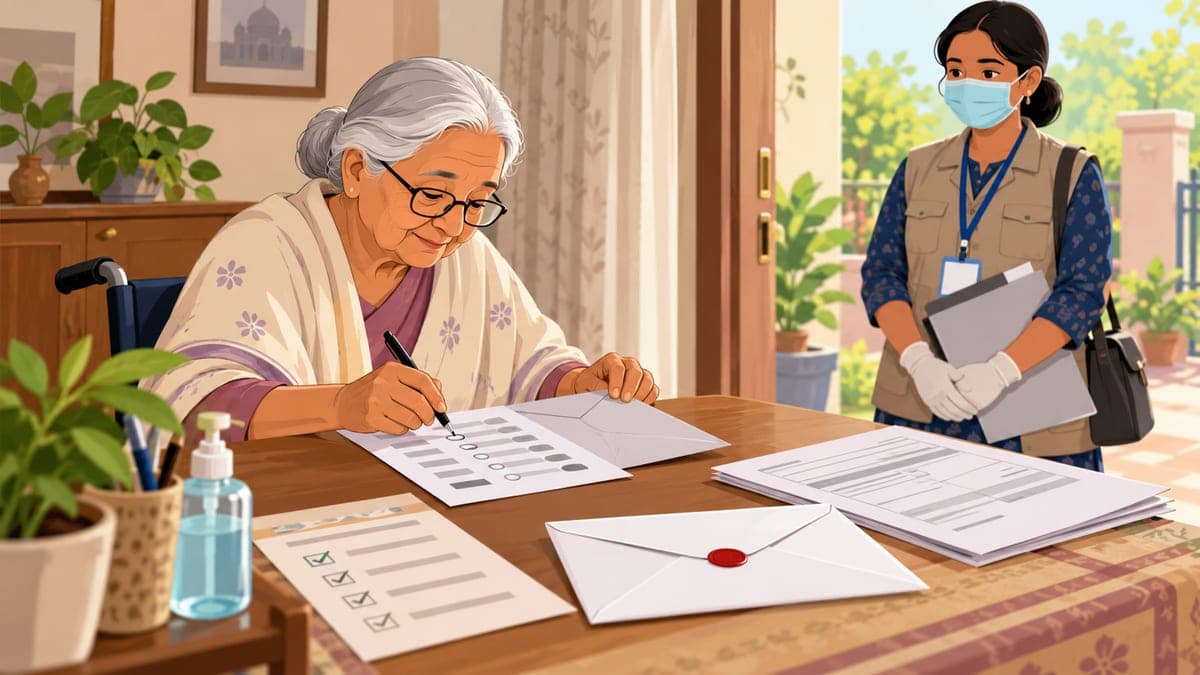
By the Janadesh Online editorial team.
Voting in person is the rule, postal voting the exception
Section 59 of the Representation of the People Act, 1951 says that votes are given by ballot as prescribed, and that, save as the Act expressly provides, no votes are received by proxy. Voting at the polling station is therefore the norm.
Section 60 lets the rules provide for exceptions. Certain service voters may vote in person, by post or by proxy. Other service voters and their spouses may vote in person or by post. Any class of persons notified by the Election Commission may vote by post only, and so may a person held under preventive detention. The detailed procedure sits in Rules 17 to 27L of the Conduct of Elections Rules, 1961.
A postal ballot does not give anyone a right to vote that they would not otherwise have. The Commission tells Returning Officers that this method cannot empower a person who has no right to vote under section 62 of the Act. The voter must already be on the electoral roll.
Who can vote by post
| Category | How they get and cast the ballot | Form |
|---|---|---|
| Service voters (armed forces, Army Act forces, State armed police serving outside the State, Government staff posted abroad) | No application needed. The Returning Officer sends a ballot to every service voter in the service part of the roll, electronically (see below). Armed forces and Army Act forces may instead appoint a proxy. | None to apply; 13A on return |
| Voters on election duty | Apply through the Returning Officer, then vote at a facilitation centre, not in any other manner | 12 (12A and 12B if voting in person in their own constituency) |
| Electors under preventive detention | Postal ballot is the only way to vote; the detainee can apply to the Returning Officer directly | As prescribed |
| Absentee voters: above 85 years | Vote at home, by postal ballot, if they opt in | 12D |
| Absentee voters: persons with 40% or more benchmark disability | Vote at home, by postal ballot, if they opt in; certificate attached | 12D |
| Absentee voters: essential services | Apply through the department nodal officer; vote at a Postal Voting Centre | 12D |
The category of "absentee voter" was introduced in 2019 by changing Rule 18. The Commission has since changed who falls in it. According to its own training material, the category was modified in June 2020 and again in March 2024.
The classes under section 60(c) are notified by the Commission. As of 2026-09-25, its most recent notice we could read is that of 19 March 2026, for the assembly elections then under way. It notified electors above 85 years and PwDs flagged in the rolls, and said essential services such as fire, health, electricity, traffic, ambulance, aviation and long-distance state road transport are covered. It also included media persons authorised by the Commission for poll-day coverage. Check the notification for the election in question, as the list can change.
Voting from home: over 85 years and benchmark disability
The Commission offered home voting for elderly and disabled voters for the first time at a Lok Sabha election in 2024. It is optional. The Press Information Bureau reported that over 1.7 crore voters above 85 years and PwDs with 40% benchmark disability were eligible.
- Fill Form 12D
The elector submits it to the Returning Officer within five days of the election notification. The date of notification is not counted.
- Attach proof if needed
PwD electors attach a benchmark disability certificate under the Rights of Persons with Disabilities Act, 2016. For those above 85 years the age shown in the roll is used and no extra certificate is needed.
- The Booth Level Officer collects the form
The BLO visits the elector at home after the announcement of elections. Candidates receive the list of such electors.
- A polling team visits
A team of polling staff and security personnel visits at an intimated time, and the process is videographed. If the elector is absent, the team leaves a note and returns once.
- The ballot is sealed and returned
The elector marks the ballot in secret, and the team takes it back for counting.
The choice is final. The Commission tells Returning Officers that a choice once exercised cannot be reversed, so an elector who opts for a postal ballot cannot then vote at the polling station.
Service voters and the electronic ballot
Since a 2016 change to Rule 23, a postal ballot for a service voter can be sent electronically. This is the Electronically Transmitted Postal Ballot System (ETPBS). The Returning Officer sends the ballot as soon as the list of contesting candidates is final. The voter prints it, marks it, and returns it by post. The voter pays nothing for the return post.
- Step 1Candidates finalised
The Returning Officer sends the ballot electronically to each service voter.
- Step 2Voter marks and seals
The ballot goes in the inner cover (Form 13B). The voter signs the declaration (Form 13A) and gets it attested.
- Step 3Return by speed post
The sealed outer cover (Form 13C) is posted back, tracked, at no cost to the voter.
- Step 4Received by 8:00 AM on counting day
A QR code on the covers and the declaration is read to check that the ballot is genuine.
How postal ballots are counted
- 8:00 AM
Counting of postal ballots begins at the Returning Officer's table. Under Rule 54A they are taken up first. Only those received by the hour fixed for counting are counted.
- 8:30 AM
EVM counting can begin, 30 minutes after postal counting starts, and continue alongside it.
- Penultimate EVM round
Since the Commission's instruction of 25 September 2025, this round is taken up only after postal counting is complete.
Before an inner cover is opened, the Returning Officer checks the declaration in Form 13A. The ballot is rejected, unopened, if the declaration is missing, is not signed or attested by a competent officer, or its serial number does not match the inner cover. A ballot is not rejected only because an attesting officer did not put a seal, if the name and designation are given. All rejections for defects in the declaration are re-verified by the Returning Officer.
Where the winning margin is smaller than the number of postal ballots rejected as invalid, the Returning Officer must personally re-examine every rejected postal ballot, and the Observer and the officer record the findings before the result is finalised.
The counting handbook cited here dates from 2023, and its figure for the elderly age limit (80) has since been replaced. This guide uses the current figure, above 85 years, from the Commission's 2024 and 2026 notices.
Frequently asked questions
Can I choose a postal ballot if I am 70 and cannot walk to the booth?
Not on age alone. As of 2026-09-25, the Commission has notified electors above 85 years and PwDs flagged in the rolls. A person with a benchmark disability of 40% or more can apply with a certificate on Form 12D. Otherwise, the voter votes at the polling station.
Do service voters have to apply for a postal ballot?
No. According to the Commission's guidelines, a service voter has no option of voting at a polling station, so the Returning Officer issues a postal ballot to all service voters in the roll. Armed forces and Army Act forces personnel who have appointed a proxy do not get one.
What if I opt for home voting and then want to vote at the booth?
The Commission's instructions to Returning Officers say the choice, once exercised, is final. Think before submitting Form 12D.
What happens if the polling team finds nobody at home?
The Commission's training material says the team leaves a note giving the time of a second visit. If the elector is absent at the second visit, no further visit is made.
Are postal ballots counted before EVM votes?
Yes, they are taken up first at the Returning Officer's table, and EVM counting can start 30 minutes later. Since 25 September 2025, the penultimate EVM round waits until postal counting is over.
Can a postal ballot arrive after counting has begun?
Postal ballots must reach the Returning Officer by 8:00 AM on counting day, as stated in the March 2026 notice for that round of assembly elections. Electronically transmitted ballots received after the hour fixed for counting are not counted, according to the counting handbook.
Explore the data
Want to see this in real numbers? These pages on Janadesh Online show it for every election we cover.
Sources
- Representation of the People Act, 1951, section 60
- Conduct of Elections Rules, 1961
- Conduct of Elections (Amendment) Rules, 2023
- ECI: Guidelines on Postal Ballot Papers, letter of 31 October 2023 (PDF)
- ECI training material for Returning Officers, Theme 8B: Postal Ballot (PDF, as on 31 August 2024)
- PIB, 19 March 2026: ECI to facilitate elderly, PwD and service voters and voters on election duty to vote by postal ballot
- PIB, 12 April 2024: Citizens above 85 years and PwDs start voting from home
- PIB, 25 September 2025: Election Commission further streamlines the counting of postal ballots
- ECI: Handbook for Counting Agent, 2023 (PDF)
- ECI SVEEP: Service voters
Janadesh Online is independent and not affiliated with the Election Commission of India. Rules and procedures can change between elections; the Commission’s own notices are the authority. Spotted an error? Tell us on the contact page.