
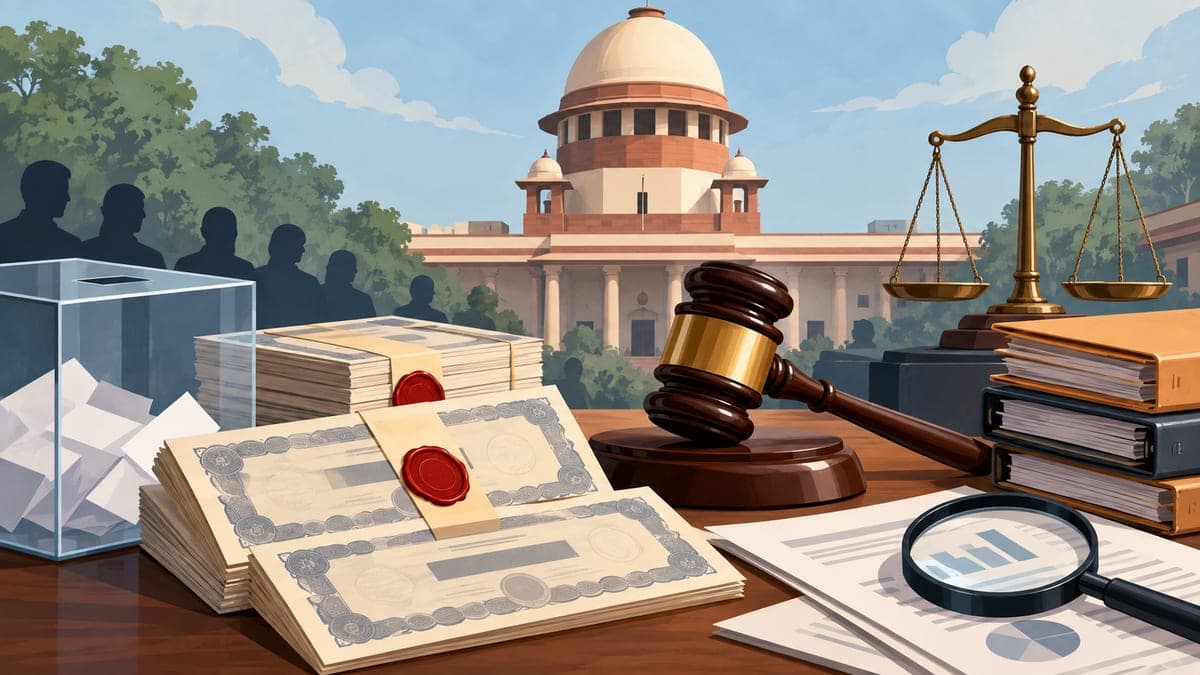
How parties are funded, and why the Supreme Court struck down electoral bonds
Parties can take donations from individuals and companies, but the law asks them to report the larger ones. For six years electoral bonds let donors stay anonymous. In February 2024 the Supreme Court held the scheme unconstitutional.
By the Janadesh Online editorial team.
What the law lets parties accept
Section 29B of the Representation of the People Act, 1951 allows a political party to accept any voluntary contribution from a person or company, except a Government company. It bars contributions from foreign sources.
Section 29C then adds a disclosure duty. Each financial year the party's treasurer prepares a report of contributions above Rs 20,000 from any person, or from a company other than a Government company. The report is sent to the ECI before the due date for filing the party's income-tax return. If a party fails to do so, it gets no tax relief under the Income-tax Act. The prescribed report is Form 24A under rule 85B of the Conduct of Election Rules, 1961.
Income-tax section 13A, added in 1978, is the exemption on the tax side. The Rs 20,000 threshold for keeping records of contributions was raised from Rs 10,000 by the Election and Other Related Laws (Amendment) Act, 2003.
The ECI has said contributions to registered unrecognised parties are fully exempt from income tax, and in a 2022 press note it reported that 2,174 such parties had not submitted contribution reports. That number is from 2022.
The Electoral Bond Scheme, 2018
The scheme was notified on 2 January 2018 under section 31(3) of the RBI Act. The bond was a bearer instrument in the nature of a promissory note. It carried no name of buyer or payee. Its arrival came with amendments in the Finance Act, 2017, which removed the requirement to record contributions received by bond, and allowed donations above Rs 2,000 only by cheque, draft, ECS or bond.
- Rs 1,000 to Rs 1 croredenominations: Rs 1,000; 10,000; 1 lakh; 10 lakh; 1 crore
- 15 daysvalidity; unused bonds went to the Prime Minister's Relief Fund
- 1%minimum vote share for a party to be eligible to encash
- 1 bankState Bank of India was the authorised bank
- Buyers: an Indian citizen, or an entity incorporated or established in India.
- Sale windows: ten days every quarter, in January, April, July and October.
- Eligible parties: registered under section 29A, with at least 1% of votes at the last Lok Sabha or Assembly general election, encashing through a bank account.
- Buyer information was kept confidential, to be disclosed only to a court or on registration of a criminal case.
The 15 February 2024 judgment
A Constitution Bench of Chief Justice D.Y. Chandrachud and Justices B.R. Gavai, J.B. Pardiwala and Manoj Misra decided Association for Democratic Reforms v. Union of India. It held the Electoral Bond Scheme, the proviso to section 29C(1) of the RP Act, section 182(3) of the Companies Act and section 13A(b) of the Income-tax Act, as each was amended by the Finance Act, 2017, violate Article 19(1)(a) and are unconstitutional.
The Court also held that deleting the proviso to section 182(1) of the Companies Act, which had allowed unlimited corporate contributions, was arbitrary and violated Article 14.
- At once
The issuing bank must stop issuing electoral bonds.
- By 6 March 2024
The State Bank of India gives the ECI details of bonds bought since the interim order of 12 April 2019: date, purchaser and denomination, and the parties that encashed them.
- By 13 March 2024
The ECI publishes the information on its website.
- Bonds still valid
Bonds inside the 15-day window and not encashed go back to the issuing bank, which refunds the buyer.
This page has not independently verified what happened after the deadlines above, including the actual disclosures and any later litigation. For events after 15 February 2024, check the ECI website and current news reports.
Frequently asked questions
Is there still a Rs 20,000 rule for party donations?
Yes. Under section 29C, a party's treasurer reports contributions above Rs 20,000 from any person or company, other than Government companies, to the ECI each financial year. The proviso that exempted electoral bonds from this was struck down.
Can parties accept foreign money?
No. Section 29B bars contributions from foreign sources, while allowing voluntary contributions from persons and companies other than Government companies.
Why did the Supreme Court strike down electoral bonds?
It held the scheme and the linked changes to the RP Act, the Companies Act and the Income-tax Act violated the right to information under Article 19(1)(a), and that removing the limit on corporate donations was arbitrary under Article 14.
What is Form 24A?
It is the report of contributions above Rs 20,000 that a party files with the ECI under section 29C and rule 85B of the Conduct of Election Rules, 1961.
Could a buyer of a bond be identified?
Under the scheme, buyer information was confidential, to be disclosed only to a court or when a criminal case was registered. The judgment ordered the State Bank of India to hand purchase details to the ECI for publication.
Explore the data
Want to see this in real numbers? These pages on Janadesh Online show it for every election we cover.
Sources
- Supreme Court: Association for Democratic Reforms v. Union of India (electoral bonds), 15 February 2024
- The Representation of the People Act, 1951 (PDF, Delhi State Election Commission copy)
- ECI press note ECI/PN/51/2022, 25 May 2022: compliance by registered unrecognised political parties
Janadesh Online is independent and not affiliated with the Election Commission of India. Rules and procedures can change between elections; the Commission’s own notices are the authority. Spotted an error? Tell us on the contact page.