
Election symbols and party recognition: who gets a symbol and why
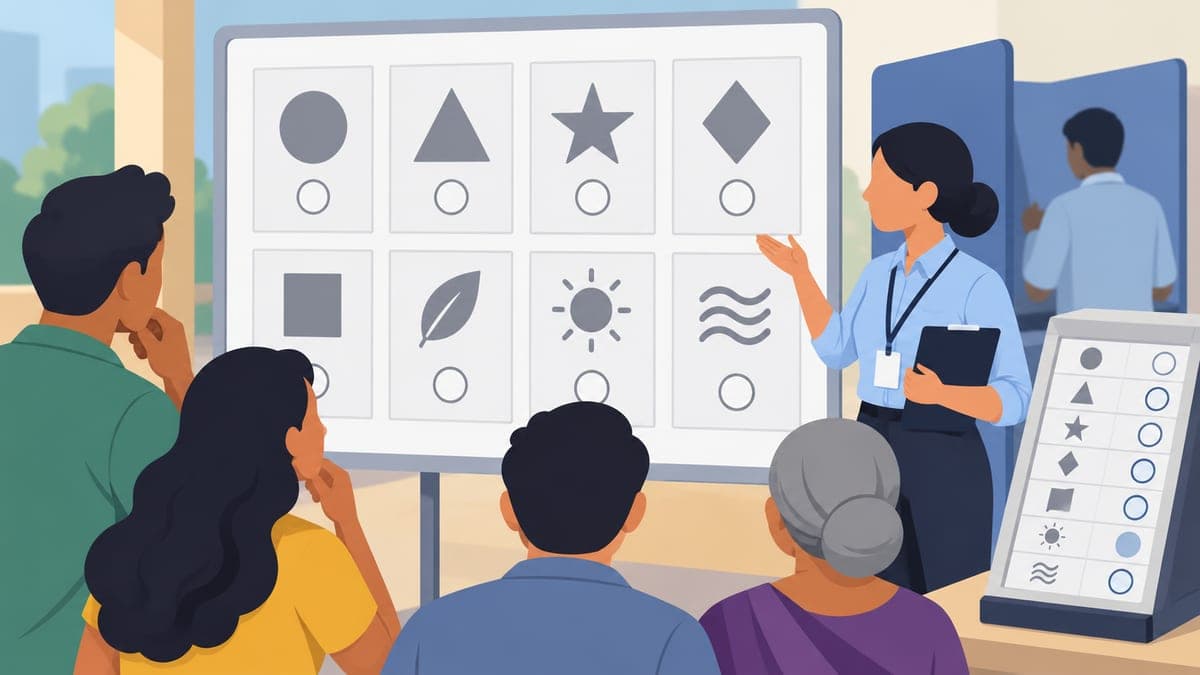
The symbol on the voting machine is not decoration. Under the Symbols Order, it depends on whether a party is registered, recognised, national or state, and it can be fought over in court. This guide follows the rules.
By the Janadesh Online editorial team.
Step one: registration under section 29A
Any association of citizens calling itself a political party has to apply to the Election Commission of India (ECI) for registration under section 29A of the Representation of the People Act, 1951. The application must be made within 30 days of the party being formed, and signed by its chief executive officer.
The party must attach its memorandum or rules, and they must contain a specific provision of true faith and allegiance to the Constitution and to the principles of socialism, secularism and democracy, and a promise to uphold the sovereignty, unity and integrity of India. The Commission can ask for more details, decides after hearing the applicant, and its decision is final. Any later change of name, address or office-bearers has to be reported without delay.
Registration alone gives a party legal existence for election purposes. The ECI has also said a registered party must undertake to contest an election within five years of registration, a condition it links to section 29A(6). Registered parties that are not recognised are called registered unrecognised parties.
National party or state party
Under paragraph 6 of the Symbols Order, a party is either recognised or unrecognised, and a recognised party is either a National party or a State party. The tests are in paragraphs 6A and 6B. A party needs to meet only one of the conditions listed for each status.
- 6% of valid votes in the state at the last Assembly election, plus at least 2 Assembly seats
- 6% of valid votes from the state at the last Lok Sabha election, plus at least 1 Lok Sabha seat from the state
- At least 3% of the Assembly seats, or at least 3 seats, whichever is more
- At least 1 Lok Sabha seat for every 25 seats (or fraction) allotted to the state
- 8% of total valid votes in the state at the last Lok Sabha or Assembly election (added in 2011)
- 6% of valid votes in each of four or more states at the last Lok Sabha or Assembly election, plus at least 4 Lok Sabha seats
- At least 2% of all Lok Sabha seats, with winners from at least 3 states
- Recognised as a State party in at least four states
Recognition is not lost at the first miss. Under paragraph 6C, a party that fails these tests at the general election after the one that earned it recognition is still treated as recognised; whether it keeps the status after a further election depends on meeting paragraph 6A or 6B. Paragraph 7 also treats a party registered after the last general election, including one formed by a split, as not meeting the tests.
The Commission publishes its lists of national parties, state parties and unrecognised parties in the Gazette, and they change after each general election. As reported after the ECI order of 10 April 2023, the national parties were six: the BJP, the Congress, the CPI(M), the BSP, the AAP and the NPP, after the TMC, NCP and CPI were derecognised as national parties. Check the ECI website for the current list.
Reserved and free symbols
Symbols are either reserved or free. A reserved symbol is kept for the exclusive use of the candidates of a recognised party: a National party gets one across the country, and a State party gets one in its own state. A free symbol is any other symbol on the Commission's list, and it goes to anyone else. Two candidates in the same constituency can never be given the same symbol.
A candidate counts as "set up" by a party, and so gets its symbol, only if certain steps are followed. The candidate must declare it in the nomination paper and be on the party's rolls. The party must also deliver Form B, signed in ink by an authorised office-bearer whose name and specimen signature were given in Form A, to the Returning Officer by 3 pm on the last day for nominations.
How independents and small parties get a symbol
- The candidate picks from the free list
Each candidate who is not a recognised-party nominee names a choice from the free symbols listed for that state or Union Territory.
- One choice, one symbol
If only one candidate has chosen a symbol, the candidate gets it.
- Clashes: unrecognised party first
If several choose the same symbol, it goes first to a candidate set up by a registered unrecognised party.
- Then a sitting member
Failing that, it goes to a sitting member who held that symbol at the previous election.
- Last resort: a draw
If none of these apply, the Returning Officer decides by lot.
When a party splits
Paragraph 15 covers the case where rival groups each claim to be the recognised party. The Commission may, after considering all the facts and hearing the groups, decide that one of them is the party, or that none is. Its decision binds all the rival groups. The Commission can also suspend or withdraw recognition for failing to follow the Model Code of Conduct, after giving the party a chance to show cause.
The Supreme Court upheld paragraph 15 in Sadiq Ali v. Election Commission of India (11 November 1971), a challenge arising from the split of the Congress. It held the paragraph is within the Commission's powers under Article 324. It called the test of numerical strength "a very valuable and relevant test", found that comparing the two groups' aims and objects did not help, and held that the party constitution was of little assistance. The Court rejected the argument that the majority in the party's Working Committee should carry decisive weight, and the Commission had recognised the Jagjivan Ram group as the Congress.
The Court treated numerical strength as the most useful test in that case. For the details of any recent split, read the Commission's own order.
Frequently asked questions
Is a registered party the same as a recognised party?
No. Registration under section 29A gives a party legal standing. Recognition as a national or state party needs the vote or seat thresholds in paragraphs 6A and 6B of the Symbols Order.
Can two candidates in one constituency have the same symbol?
No. Paragraph 4 of the Symbols Order says different symbols are allotted to different contesting candidates in the same constituency.
What happens to an independent who wants a popular symbol?
Independents choose from the free-symbol list. If several ask for the same one, an unrecognised party candidate gets it first, then a sitting member who held it earlier, and otherwise the Returning Officer draws lots.
Can the Election Commission take away a party's recognition?
Yes. Paragraph 16A lets it suspend or withdraw recognition for not observing the Model Code of Conduct or its lawful directions, after the party has a chance to show cause. A party can also lose recognition when it no longer meets the tests in paragraph 6A or 6B.
Who keeps the symbol when a party splits?
Under paragraph 15, the Election Commission decides which rival group, if any, is the party. In Sadiq Ali (1971) the Supreme Court held that the numerical strength of each group is a relevant test.
Explore the data
Want to see this in real numbers? These pages on Janadesh Online show it for every election we cover.
Sources
- ECI: Political Parties and Election Symbols 2024, incl. the Symbols Order, 1968 as amended to March 2024 (PDF)
- The Representation of the People Act, 1951 (PDF, Delhi State Election Commission copy)
- Supreme Court: Sadiq Ali v. Election Commission of India, 11 November 1971
- ECI press note ECI/PN/51/2022, 25 May 2022: compliance by registered unrecognised political parties
- The Tribune: Election Commission derecognises NCP, TMC and CPI as national parties (April 2023)
Janadesh Online is independent and not affiliated with the Election Commission of India. Rules and procedures can change between elections; the Commission’s own notices are the authority. Spotted an error? Tell us on the contact page.